Ebstein's Anomaly
About Ebstein's Anomaly | Ebstein's Anomaly Signs / Symptoms | Diagnosis | Ebstein's Anomaly Treatments | Treatment Results
What is Ebstein's Anomaly?
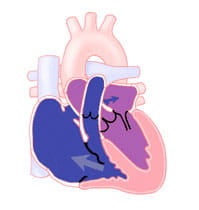
Ebstein's anomaly is an abnormality in the tricuspid valve. The tricuspid valve separates the right atrium (the chamber that receives blood from the body) from the right ventricle (the chamber that pumps blood to the lungs).
In Ebstein's anomaly, two leaflets of the tricuspid valve are displaced downward into the pumping chamber. The third leaflet is elongated and may be tethered to the wall of the chamber. Rarely, the valve is so deformed that it will not allow blood to flow easily in the normal direction (right atrium to right ventricle).
More commonly, these abnormalities cause the tricuspid valve to leak blood backwards into the right atrium when the right ventricle contracts. As a result, the right atrium becomes enlarged. If the tricuspid regurgitation (leak) is severe enough, congestive heart failure can result.
If there is excessive backflow into the right atrium, the pressure within the right atrium becomes very high. Normally, a fetus has a communication or hole between the right atrium and left atrium known as the foramen ovale or PFO. The PFO usually closes after birth.
In Ebstein’s Anomaly, the high pressure in the right atrium keeps the PFO open. This connection allows unoxygenated ("blue") blood to flow from the right atrium, bypassing the lungs and going directly to the body. This will result in lower oxygen levels in the blood. This is why children with Ebstein’s anomaly may be blue or “cyanotic”, and have low oxygen saturation.
Ebstein's anomaly may occur with other heart lesions, such as pulmonary valve stenosis or atresia, atrial septal defect or ventricular septal defect. In addition, many patients with Ebstein's anomaly have an accessory (extra) conduction pathway in the heart (Wolff-Parkinson-White syndrome) leading to episodes of abnormal fast heart rate (supraventricular tachycardia.)
What signs or symptoms are associated with Ebstein's anomaly?
Ebstein's anomaly can range from very mild to very severe. Many patients with milder forms of Ebstein's anomaly do not have symptoms are diagnosed due to the presence of a heart murmur. Abnormal or extra heart sounds may also be present on the physical examination.
Some babies and children have bluish discoloration to their lips and nail beds (cyanosis), due to the flow of blood from the right atrium to the left atrium. Children may complain that their heart races, skips a beat, “beats funny” or "hiccoughs." They may tire more easily than other children or become short of breath, particularly during play. In adolescents and young adults, the sensation of "heart skipping" (palpitations) or fast heart rate, shortness of breath, and chest pain may be the first symptoms. Growth and development are usually normal in patients with Ebstein's anomaly.
Severely affected babies are often critically ill at birth, with low oxygen saturations (cyanosis) and heart failure requiring intensive care.
Return to Top
How is the diagnosis of Ebstein's anomaly made?
A chest X-ray will be taken to judge the size of the heart, which may be quite enlarged. Often, the diagnosis of Ebstein's anomaly is suspected because of the very large heart on chest X-ray.
An echocardiogram is used to definitively diagnose Ebstein's anomaly and identify any accompanying heart defects. This test allows the pediatric cardiologist to determine the degree of valve displacement, the severity of valve leakage (insufficiency) or valve narrowing (stenosis), the size of the heart chambers, and if a patent (open) foramen ovale is present.
An electrocardiogram (ECG) records the heart's rhythm. If the child has complained about a racing heart and the answer is not found in this initial test, he / she may go home with a recorder which is used to try to capture the episodes of tachycardia (rapid heart rate). Your child may also have an exercise stress test performed to better assess his / her heart function during activity.
Invasive diagnostic testing is not as commonly performed today as in the past due to the availability of better noninvasive techniques. Certain patients with Ebstein's anomaly, however, may require cardiac catheterization to fully define their cardiac anatomy and function.
Some patients with abnormal heart rhythms may require electrophysiologic testing to better identify and potentially treat their heart rhythm problems.
Return to Top
How is Ebstein's anomaly treated?
Your child's pediatric cardiologist will discuss the treatment options appropriate for your child. Mild defects may require no specific treatment, only prophylaxis for bacterial endocarditis. Medical treatment is used to help children with congestive heart failure or abnormal heart rhythms.
Surgery may be indicated, depending on a child's specific circumstances. Surgical repair or replacement of the tricuspid valve and closure of the formamen ovale or atrial septal defect may be recommended. Surgery might be indicated in older children with moderate to severe congestive heart failure, significant heart enlargement, cyanosis, or abnormal clot formation.
Abnormal accessory conduction pathways that allow fast heart rates (supraventricular tachycardia) to develop may be ablated (removed) using procedures in the catheterization laboratory.
Medical therapy for heart failure or arrhythmias is typically used in conjunction with planned surgical intervention. In very severe forms of Ebstein's anomaly, an operation may be required in the newborn period and the treatment strategy is more like that for children with single ventricle cardiac anomalies.
Return to Top
What are the results of treatment?
Without any treatment, the natural history of Ebstein’s anomaly is gloomy. A 1971 study reported that only 50% of patients survived to 13 years of age.
Children treated with medicines only have excellent results and few complications. A study in 1974 of 505 patients showed that most patients who survived to childhood had few or no symptoms and relatively normal heart function.
Children who have surgery generally do well. Complications are usually early. Surgical outcomes were reported in a study of 189 patients with Ebstein's anomaly who had surgical repair or replacement of the tricuspid valve. Over half of these patients had valve repair, while 36 percent had valve replacement. Twelve patients (6%) died within the first postoperative month. Ten patients (5%) died after this first month. But more than 80% of children survived to 20 years of age. Heart failure status significantly improved in 93% of the 177 surviving patients.
Return to Top
You must have Macromedia Flash Player installed on your computer to view many of the files in the Heart Institute Encyclopedia. You can download Macromedia Flash Player at Macromedia's website.
Rev. 7/09