Cincinnati Children's Hospital Medical Center Logo

Cancelas Lab

Cancelas Laboratory Research Interests

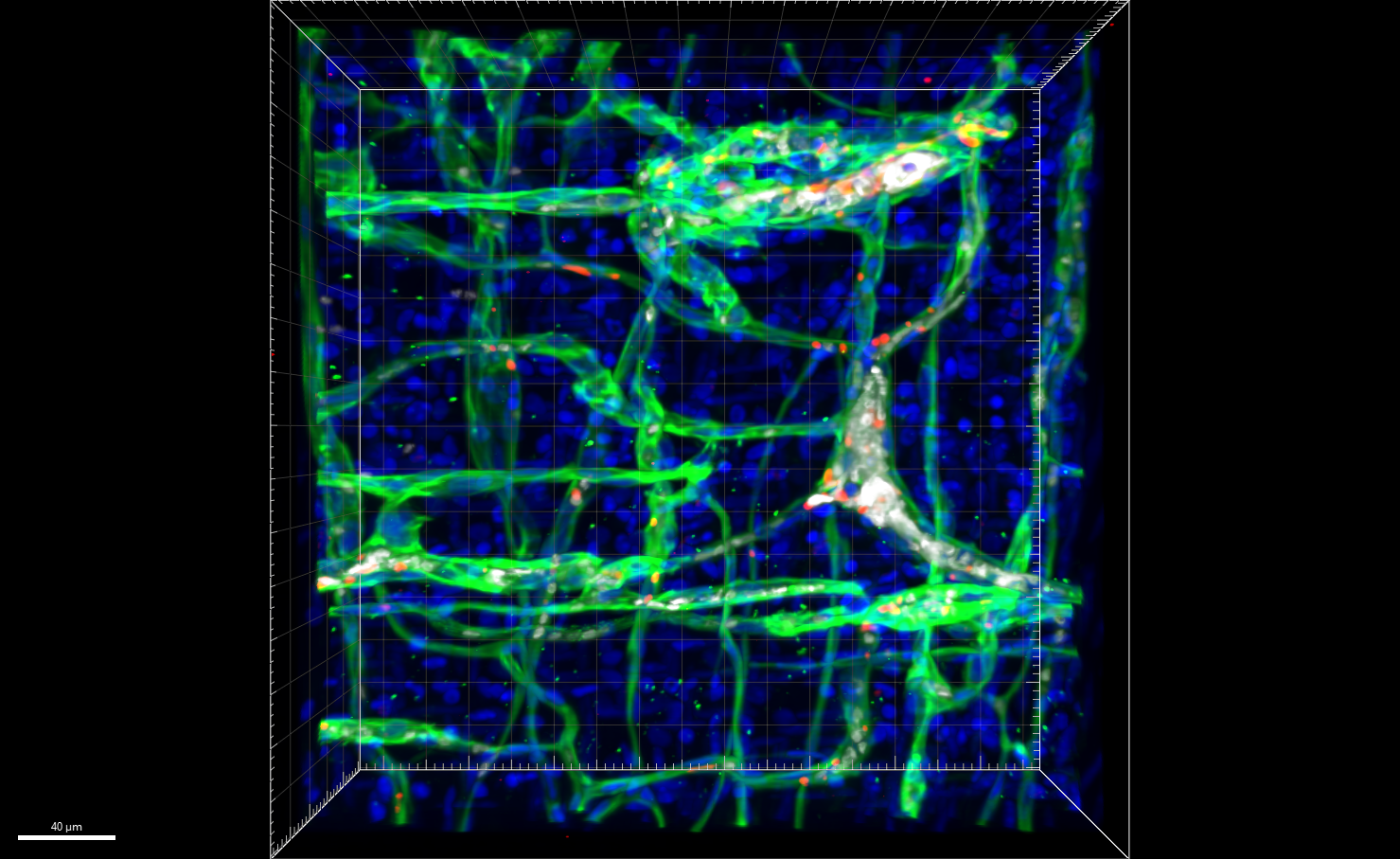
Our laboratory focuses on the study of blood-forming cells during the process of adult hematopoiesis. Billions of cells are produced daily in a crucially regulated fashion to maintain homeostatic cell counts in circulation and provide all functional blood cell types (neutrophils, eosinophils, basophils, monocytes/macrophages, platelets, and erythrocytes) and other tissue cells (mast cells and osteoclasts). Adult hematopoiesis is located in the bone marrow and is initiated by hematopoietic stem cells (HSC), which are able to self-renew and differentiate into all functional types of blood cells. HSC attract clinical interest because of their potential use in stem cell and gene therapy and because of their involvement in leukemia.

Despite the advance in the understanding of how stem cells proliferate and differentiate, we do not fully understand the mechanisms that control the bone marrow stem cell compartment. One of the major challenges has been to understand the role of the "bone marrow microenvironment" in the regulation of the proliferation and differentiation of HSC. Although poorly characterized, this microenvironment is formed by stromal cells, including myofibroblasts, adipocytes and osteoblasts--that originate from mesenchymal progenitors--and hematopoietic-derived cells such as lymphocytes and macrophages, and from extracellular matrix proteins (collagen, fibronectin, vitronectin, laminin, hemonectin, among others). The stroma provides growth factors, chemoattractants, anchorage, and scaffolding for the correct development of hematopoiesis. 

In the last years we have focused our interest in the molecular determinants that regulate the proliferation, survival, homing and retention of hematopietic stem cells in relation with the so-called "stem cell niche" in benign and malignant hematopoiesis.

Research in the Cancelas Laboratory at Cincinnati Children's Hospital and Hoxworth Blood Center focuses on:

  • Role of the Rho GTPase Rac in the regulation of HSC engraftment and mobilization.
    In collaboration with Drs. David A. Williams and Yi Zheng in the Division of Experimental Hematology of Cincinnati Children's Hospital Medical Center, our laboratory investigates the mechanism(s) of the deficiency of engraftment of Rac-deficient stem cells and manipulate HSC by inhibiting Rac function in order to achieve more satisfactory ways of HSC mobilization.

Related Readings

Where possible, article titles are linked to an abstract of the article.  Selected citations may also be linked to PDFs for the article available on a Journal's site.  Depending on the Journal's publishing policy, you may need a subscription to download the PDF.

pdf iconGu Y, Filippi MD, Cancelas JA, Siefring JE, Williams EP, Jasti AC, Harris CE, Lee AW, Prabhakar R, Atkinson SJ, Kwiatkowski DJ, Williams DA:  Hematopoietic cell regulation by Rac1 and Rac2 guanosine triphosphatasesScience 302: 445-449, 2003.

pdf iconCancelas JA, Lee AW, Prabhakar R, Stringer KF, Zheng Y, Williams DA: Rac GTPases differentially integrate signals regulating hematopoietic stem cell localization. Nature Medicine, 11(8):886-91, 2005.

pdf icon Cancelas JA, Jansen M, Williams DA: The role of chemokine activation of Rac GTPases in hematopoietic stem cell marrow homing, retention, and peripheral mobilization. Exp Hematol. 34(8): 976-85, 2006.

  • Analysis of the role of stromal cells in hematopoiesis.
    Our laboratory is analyzing the role of connexin43 in the regulationof the hematopoietic microenvironment.

Related Readings

pdf iconCancelas JA, Koevoet WLM, de Koning AE, Mayen AEM, Rombouts EJC, Ploemacher RE: Connexin-43 gap junctions are involved in multiconnexin-expressing stromal support of hemopoietic progenitors and stem cells. Blood 96(2): 498-505, 2000.

pdf iconPresley CA, Lee AW, Kastl B, et al. Bone marrow connexin-43 expression is critical for hematopoietic regeneration after chemotherapy. Cell Commun Adhes. 2005 Jul-Dec;12(5-6):307-317.

  • Role of the fusion gene FIP1a/PDGFR1a in the development of hypereosinophilic syndrome.
    In collaboration with Dr. Marc Rothenberg (Allergy/Immunology Division) and Dr. David A. Williams (Experimental Hematology), we are analyzing in vivo and in vitro models of this human disease by retroviral transduction of the most common fusion gene found in this disease.

Related Readings
pdf icon Yamada Y, Rothenberg ME, Lee AW, Akei HS, Brandt EB, Williams DA, Cancelas JA.: The FIP1L1-PDGFRA fusion gene cooperates with IL-5 to induce murine hypereosinophilic syndrome (HES)/chronic eosinophilic leukemia (CEL)-like disease. Blood;107(10):4071-9,2006.

  • In addition, The Research Laboratory of Hoxworth Blood Center is one of the leaders in coordination of research projects developed for the advancement of transfusion medicine, including clinical trials for transfusion medicine-related products.  These projects encompass a broad range of studies, including analysis of red blood cells, platelets, and plasma, and evaluation of techniques that improve the quality of blood components during storage, leukoreduction and freezing-thawing.

Related Readingspdf icon AuBuchon JP, Cancelas JA, Hershel L, Roger J, Rugg N, Pratt PG, Joines A, Gormas JF, Zia M, Spearman MR. In vitro and in vivo evaluation of LEUKOSEP HRC-600-C leukoreduction filtration system for red cells. Transfusion. 46(8):1311-5,2006.

    Contact Us

    For further information regarding Dr. Cancelas' research, please contact Dr. Jose A. Cancelas at 513-636-5879 at Children's Hospital Medical Center or at 513-558-1324 at Hoxworth Blood Center.  For additional information about the Division of Experimental Hematology, please contact Dr. David Williams at 513-636-0364. The Division of Experimental Hematology can be found in Room 6529 of Location R (Research Foundation Building).