Show All
What is Amniotic Band Syndrome / ABS?
Amniotic Band Syndrome / ABS is a group of congenital abnormalities caused by bands of amnion (inner lining of the "bag of waters") that attach to the fetus.
Abnormalities result from attachment or constriction that lead to webbing of fingers and / or toes, amputation of limbs, severe defects of the head and face, spine, umbilical cord and / or body wall.
The term amniotic band syndrome / ABS encompasses many congenital anomalies, including:
- Amniotic band disruption complex
- Amniochorionic mesoblastic fibrous strings
- Aberrant tissue bands
- Amniotic deformity
- Adhesions and mutilations (ADAM complex)
- Amniotic adhesion malformation syndrome
- The limb and / or body wall defect
What Causes Amniotic Band Syndrome / ABS?
There are several theories as to the cause of Amniotic Band Syndrome / ABS. The most widely accepted is a rupture of the amnion occurring early in gestation. The fibrous bands of amnion that occur from the amniotic rupture encircle the limbs, resulting in tourniquet-like defects and intrauterine amputations.
The timing of the rupture is believed to occur between 28 days after conception to 18 weeks of gestation. However, late bands can occur and present at birth with multiple abnormalities of the limbs, even after a normal sonogram was performed earlier in gestation. This can be observed following any form of intervention such as amniocentesis or fetal surgery.
What is the Incidence of ABS?
Amniotic Band Syndrome / ABS is difficult to diagnose. The estimates of its incidence vary widely, from one in 1,200 to one in 15,000 live births.
How is Amniotic Band Syndrome Diagnosed?
The earliest that amniotic bands have been detected was at 12 weeks gestation, by vaginal ultrasound. Bands may be difficult to detect by ultrasound, and are more often diagnosed by the effect they have on the fetal anatomy, as in the case of missing or misshapen limbs.
Amniotic Band Syndrome / ABS may affect the face with cleft lip or palate, asymmetric microphthalmia or severe nasal deformity. Encephalocele may be a manifestation of Amniotic Band Syndrome / ABS, especially when eccentrically placed off the midline.
Abdominal-wall defects, typically large defects with free-floating intestine but large enough for the lines to herniate outside the abdomen, can also be the result of Amniotic Band Syndrome / ABS.
The characteristic appearance of an aberrant sheet or band of amnion attached to the fetus with resultant deformity and restriction of motion allows a diagnosis of Amniotic Band Syndrome / ABS to be made. However, prenatal diagnosis is the exception rather than the rule.
The findings in Amniotic Band Syndrome / ABS may be limited to isolated defects, including isolated facial cleft, digital amputation or mild elephantiasis of an extremity beyond a constrictive band. These features may be difficult to diagnose using ultrasound because the detailed fetal visualization required is beyond the scope of routine obstetrical ultrasound examinations.
At the worst end of the spectrum, the fetus may be so severely deformed by the amniotic bands that the spine is contracted and organs are formed in perplexing and bizarre proportions. The head may be completely misshapen or absent.
The bands responsible for these deformities are rarely seen and a presumptive diagnosis of Amniotic Band Syndrome / ABS is made based on the commonly associated deformities.
The spinal deformities in Amniotic Band Syndrome / ABS can be severe, manifesting as kyphotic lordosis or scoliosis as well as severe rotational abnormalities, even spinal amputation. While spinal deformity can be seen in other syndromes, severe spinal deformity should suggest Amniotic Band Syndrome / ABS.
Spinal deformity associated with an abdominal-wall defect is particularly suggestive of Amniotic Band Syndrome / ABS. While the typical appearance of an omphalocele is possible, the more common defect is a large slash-like defect of both the thoracic and abdominal cavities with evisceration.
These defects are associated with exteriorized bowel, liver and sometimes heart without an enveloping membrane. When associated with limb abnormalities, this is characteristic of the limb-body-wall complex form of Amniotic Band Syndrome / ABS.
Deformation of the calvarium is another group of anomalies characteristic of Amniotic Band Syndrome / ABS. If complete, the fetus may appear anencephalic. If partial, the fetus may appear to have an encephalocele.
The distinguishing features that characterize these defects as amniotic band syndrome / ABS are their asymmetric nature and associated spinal deformity or abdominal-wall defects.
In classic anencephaly, the calvarial bones are symmetrically absent. In anencephaly caused by Amniotic Band Syndrome / ABS, there is some portion of calvarium present, usually near the base of the skull or near one other orbit. Similarly, classic encephaloceles occur near the midline, while amniotic band syndrome causes encephaloceles off midline.
The presence of bands is unnecessary for the diagnosis of amniotic band syndrome / ABS in the presence of characteristic fetal anomalies. Ultrasound detection of bands is helpful in confirming the diagnosis of amniotic band syndrome / ABS as the cause of fetal deformity. However, observation of these bands without fetal abnormality is not amniotic band syndrome / ABS.
It is important for the sonographer to distinguish amniotic bands from other membranes or separations within the amnion. Separation of amnion and chorion is normal in early pregnancy until fusion occurs at approximately 16 weeks of gestation.
Chorioamniotic separation may occur as a result of amniocentesis or fetal surgery, and extrachorionic hemorrhage may separate the chorioamniotic membrane from the uterine wall. In both of these instances, a membrane may be observed by ultrasound. Other causes of membranes in the developing fetus include; septate uterus, blighted twin and circumvallate placenta.
Adhesions that form in the uterus as a result of curettage, Caesarean section, or myomectomy may cause sheets of amnion to protrude into the lumen of the amniotic cavity.
Randal et al. (1988) found that 76 percent of patients with amniotic sheets had undergone prior instrumentation. This results in an adhesion that becomes covered by chorion and amnion and has a thickness similar to the intertwin membrane of dichorionic diamniotic twins. These amniotic sheets do not adhere to the fetus because the amnion is intact.
The uterine adhesion may rupture with growth of the fetus. Filly et al. (1991) have described the ultrasound appearance of these synechiae as having a thickened base and a fine edge that undulates.
There are no associated fetal abnormalities and there is free fetal movement around the sheet. Whether due to rupture or compression by the growing fetus, the synechiae may not be seen in the third trimester.
In the limb-body-wall complex (LBWC), there is a constellation of abnormalities, including myelomeningoceles or caudal regression, thoracoabdominoschisis, or abdominoschisis and limb defects. At least two of the three abnormalities listed above are necessary to make a diagnosis of LBWC.
The umbilical cord is usually short or absent, with the placenta attached to the fetus. If present, there may be only a two-vessel cord. The limbs may be missing or the feet clubbed. The spine is often short and curved, and sacral regression is common.
There may be Arnold-Chiari malformation and hydrocephalus associated with the meningomyelocele. There may be ectopia cordis as part of the thoracoabdominoschisis. Facial clefts may also be seen.
The differential diagnosis in amniotic band syndrome / ABS depends on the ultrasound findings. In isolated constrictive amniotic bands associated with distal limb edema, possible lymphatic or vascular malformations should be considered. However, color Doppler studies should closely show the flow characteristics of a vascular malformation.
Constrictive bands involving the upper extremity should suggest the possibility of the VACTERL association, if the radius is affected, and Fanconi anemia if radial hypoplasia or absent thumbs are observed.
Amniotic membranes within the amniotic cavity, without associated fetal anomalies, may be amniotic sheets secondary to intrauterine synechiae or remnant of a blighted twin, or secondary to amniocentesis or chorionic villus sampling.
The main differential diagnosis are cases of isolated neural-tube defects or ruptured omphalocele, which do not meet the criteria for LBWC. The body-stalk anomaly has a similar constellation of anomalies, but the placenta is attached to the trunk of the fetus.
There is great controversy about the pathogenesis of the various forms of amniotic band syndrome / ABS. Part of this controversy involves the timing in gestation of the development of amniotic bands. However, in constrictive amniotic bands of the extremities, the progression of constriction combined with fetal growth has resulted in extremity amputation.
Amniotic band syndrome / ABS can be associated with either polyhydramnios or oligohydramnios. Despite the severity of some forms of amniotic band syndrome / ABS, there are no adverse maternal consequences for this diagnosis.
The incidence of intrauterine fetal death from amniotic band syndrome / ABS involving the umbilical cord is not known, but numerous cases have been reported. However, the poorly characterized pathogenesis of this syndrome and limited ultrasound surveillance limit our understanding of its natural prenatal history.
Amniotic band syndrome / ABS is a relatively common, if not always appreciated, cause of fetal and neonatal morbidity and mortality. The fetal-lamb model of Amniotic Band Syndrome / ABS has been useful in defining the pathophysiology of amniotic band syndrome / ABS and to provide a tool to understand the unique fetal response to tissue injury, repair and regeneration.
Ultrasound identification of amniotic band syndrome / ABS affecting the umbilical cord may be an indication for fetoscopic surgical intervention. Intervention for non-lethal limb deformation may also be considered for signs of threatened limb loss or evidence of umbilical cord constriction.
Constrictive bands most commonly affect the extremities, but can also involve the umbilical cord, with resulting fetal death. Kanayama et al. (1995) described the reversal of diastolic flow observed in a fetus with umbilical-cord constriction due to amniotic bands.
Graf et al. (1997) similarly reported a case of amniotic bands involving the umbilical cord following the development of chorioamniotic
separation. Despite initially normal umbilical artery Doppler waveforms, this fetus died within 2 weeks from a constrictive amniotic band of the umbilical cord.
Reports have described constrictive amniotic bands as a cause of fetal death. However, until the reports by Kanayama and Graf and their colleagues, this was a diagnosis made pathologically, after the fact. It is in cases like these that fetoscopic lysis of amniotic bands can be lifesaving.

How is Pregnancy Managed with ABS?
If amniotic band syndrome / ABS is suspected, a detailed ultrasound should be conducted to assess any and all abnormalities. Fetal echocardiography is indicated in cases of abdominal-wall or abdominothoracic-wall defects because of the increased incidence of associated cardiac defects.
Amniocentesis is not necessary in clear-cut cases of amniotic band syndrome / ABS, as these are sporadic deformations with no association with chromosomal abnormalities. However, in instances in which the diagnosis is uncertain, genetic amniocentesis should be considered. For example, in cases of abdominal-wall defects in which a ruptured covered omphalocele cannot be excluded, genetic amniocentesis is indicated.
A fetus with amniotic band syndrome / ABS should pose no increased risk for the mother during pregnancy. The diagnosis of amniotic band syndrome / ABS, however, identifies a pregnancy as being at increased risk for fetal anomalies and premature labor and delivery.
There is no indication for Cesarean section, except for obstetrical indications. In cases of severe amniotic band syndrome / ABS, such as LBWC, in which survival is not anticipated, conventional labor and vaginal delivery without intervention for fetal distress should be considered.
What is the Fetal Intervention for ABS?
The indications for fetal surgery in the amniotic band syndrome / ABS may be either for a life-threatening condition if it involves constriction of the umbilical cord, or more commonly, threatened limb amputation due to amniotic band syndrome / ABS.
Torpin (1965) reported 36 cases of fetal death due to cord constriction from amniotic bands. In each case, the diagnosis was made retrospectively.
Recognition of amniotic bands constricting the umbilical cord has been reported by Kanayama et al. (1995), who were able to document fetal compromise by reversal of diastolic flow in the umbilical artery by color Doppler. In cases like the one reported by Kanayama et al. fetoscopic lysis of amniotic bands could be lifesaving.
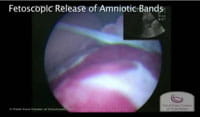
We have performed two fetoscopic procedures to release amniotic bands that threatened to amputate a hand. In both cases, fetoscopic laser release of the constrictive amniotic bands was successful. Of note in one case, an additional band around the fetal thigh was released. This band would likely have resulted in limb amputation without fetoscopic release.
The rationale for performing fetoscopic lysis of constricting extremity amniotic bands is based on the hypothesis that progressive compromise of fetal growth leads to amputation. However, this assumes that the procedure can be accomplished with no maternal morbidity and minimal fetal morbidity.
Torpin (1965) has reported 36 cases of constrictive amniotic bands of the umbilical cord, which were uniformly fatal. Although rare, umbilical-cord constriction, once diagnosed by ultrasound, may be amenable to fetoscopic release to avert fetal death.
What are Treatment Options for Newborns?
A fetus known to have amniotic band syndrome / ABS should be delivered in a tertiary-care center where neonatologists, pediatric surgeons, pediatric plastic surgeons and orthopedic surgeons are available. Treatment depends on the nature of the amniotic band syndrome / ABS and the severity of the deformation. In cases of umbilical cord involvement, early or even emergent delivery may be indicated if there are signs of fetal compromise.
After delivery, a careful physical examination should assess the severity of the amniotic band syndrome / ABS. Often, there will be no evidence of the amniotic band at the time of delivery. In cases of amniotic bands involving extremities, treatment is dictated by the severity of the deformation.
The severity of the deformity can range from a mildly constrictive band, requiring release, to near amputation, requiring debridement. More often, there is a band-like deformation that requires Z-plasties to surgically correct.
In cases of amniotic bands involving the face and head, there may be severe facial clefts, anophthalmia, and encephalocele. These deformities may require many extensive reconstructive procedures to achieve an acceptable cosmetic result. Cases of the LBWC form of amniotic band syndrome / ABS are always fatal, and no reconstructive procedures are indicated.
What is the Long-term Outcome for ABS?
The outcome in amniotic band syndrome / ABS depends on the severity of the deformation. Cases of amniotic band syndrome / ABS involving the extremities usually have an excellent long-term outcome. Even in cases of limb amputation, ambulation is possible with the aid of a prosthesis.
The cosmetic results following extensive craniofacial reconstructive surgery are often acceptable, but the severity of these defects may leave these children permanently disfigured.
Most cases of amniotic band syndrome / ABS are sporadic, and there is no risk of recurrence in subsequent pregnancies. There have been cases of amniotic band syndrome / ABS associated with underlying disease, such as Ehlers-Danlos syndrome type III or osteogenesis imperfecta.
Similarly, amniotic band syndrome / ABS has been reported in association with teratogens such as methadone and lysergic acid diethylamide exposure. While associated maternal disease or teratogenic exposure may predispose to recurrence, these are rare causes of the amniotic band syndrome / ABS.
Amniotic Band Syndrome References
Adzick NS, Sutton L, Crombleholme TM, et al. Successful fetal surgery for spina bifida. Lancet 1998;352:1675–1676.
Asherman JG. Amenorrhoea traumatic. Br J Obstet Gynaecol 1948;55:23–27.
Ashkenazy M, Borenstein R, Katz Z. Constriction of the umbilical cord by an amniotic band after midtrimester amniocentesis. Acta Obstet Gynecol Scand 1982;61:89–91.
Bamforth JS. Amniotic band sequence: Streeter's hypothesis reexamined. Am J Med Genet 1992;44:280–287.
Borlum KG. Second trimester chorioamniotic separation and amniocentesis. Eur J Obstet Gynecol Reprod Biol 1989;30: 35–38.
Burrows PE, Lyons EA, Phillips HJ, et al. Intrauterine membranes: sonographic findings and clinical significance. J Ultrasound 1982;10:1–8.
Chemke J, Gaff G, Hurwitz N, et al. The ABS. Obstet Gynecol 1973;41:332–336.
Comninos AC, Zourlas PA. Treatment of intrauterine adhesions (Asherman's syndrome). Am J Obstet Gynecol 1969; 105:862–867.
Crombleholme TM, Robertson FM, Marx G, et al. Fetoscopic cord ligation to prevent neurologic injury in monozygous twins. Lancet 1996;348:191.
Crombleholme TM, Dirkes K, Whitney TM, et al. Amniotic band syndrome in fetal lambs. I. Fetoscopic release and morphometric outcome. J Pediatr Surg 1995;30:974–978.
Daly CA, Freeman J, Weston W, et al. Prenatal diagnosis of ABS in a methadone user: review of the literature and a case report. Ultrasound Obstet Gynecol 1996;8:123–125.
Filly RA, Golbus MS. The fetus with amniotic band syndrome. In: Harrison MR, Golbus MS, Filly RA, eds. The unborn patient. 2nd ed. Philadelphia: Saunders, 1991:440–447.
Graf JL, Bealer JF, Gibbs DL, et al. Chorioamniotic membrane separation: a potentially lethal finding. Fetal Diagn Ther 1997;12:81–84.
Heifetz SA. Strangulation of the umbilical cord by amniotic bands. Pediatr Pathol 1984;2:285–304.
Herva R, Karkinen-Jaaskelainen M. Amniotic adhesion malformation syndrome: fetal and placental pathology. Teratology 1984;29:11–19.
Higginbottom MC, Jones KL. The amniotic band disruption complex: timing of amniotic rupture and variable spectra of consequent defects. J Pediatr 1979;96:544–549.
Hill L, Kislak S, Jones N. Prenatal ultrasound diagnosis of a forearm constrictive band. J Ultrasound Med 1988;7: 293–295.
Ho DM, Liu HC. The ABS: report of two autopsy cases and review of the literature. Clin Med J 1987;39:429–436.
Hong CY, Simon MA. Amniotic bands knotted about umbilical cord: a rare cause of fetal death. Obstet Gynecol 1963;22:667–670.
Huang CC, Eng HL, Chen WJ. Amniotic band syndrome: report of two autopsy cases. Chang Gung Med J 1995;18: 371–377.
Jones KL, Smith DW, Hall BD, et al. A pattern of craniofacial and limb defects secondary to aberrant tissue bands. J Pediatr 1974;84:90–95.
Kanayama MD, Gaffey TA, Ogburn PL Jr. Constriction of the umbilical cord by an amniotic band, with fetal compromise illustrated by reverse diastolic flow in the umbilical artery: a case report. J Reprod Med 1995;40:71–73.
Kaufman AJ, Fleischer AC, Thieme GA, et al. Separated chorioamnion and elevated chorion: sonographic features and clinical significance. J Ultrasound Med 1985;4: 119–125.
Keller H, Neuhauser G, Durkin-Stamm MV, et al. "ADAM complex" (amniotic deformity, adhesions, mutilations): a pattern of craniofacial and limb defects. Am J Med Genet 1978;2:81–98.
Kulkarni ML, Gopal PV. Amniotic band syndrome. Indian Pediatr 1990;27:471–476.
Lage JM, VanMarter LJ, Bieber FR. Questionable role of amniocentesis in the etiology of amniotic band formation: a case report. J Reprod Med 1988;33:71–73.
Lockwood C, Ghidini A, Romero R, et al. ABS: reevaluation of its pathogenesis. Am J Obstet Gynecol 1989;160: 1030–1033.
Lubinsky M, Sujansky E, Sanders W, et al. Familial amniotic bands. Am J Med Genet 1983;14:81–87.
Mahony BS, Filly RA, Callen PW, et al. The amniotic band syndrome: antenatal diagnosis and potential pitfalls. Am J Obstet Gynecol 1985;152:63–68.
Miller ME, Graham JM Jr, Higginbottom MC, et al. Compression-related defects from early amnion rupture: evidence for mechanical teratogenesis. J Pediatr 1981;98:292–297.
Moerman P, Fryns JP, Vandenberghe K, et al. Constrictive amniotic bands, amniotic adhesions, and limb-body wall complex: discrete disruption sequence with pathogenetic overlap. Am J Med Genet 1992;42:470–479.
Ossipoff V, Hall BD. Etiologic factors in the ABS: a study of twenty-four patients. Birth Defects 1977;13:117–121.
Patten RM, VanAllen MI, Mack LA, et al. Limb-body wall complex: in utero sonographic diagnosis of a complicated fetal malformation. AJR Am J Roentgenol 1986;146: 1019–1024.
Quintero RA, Morales WJ, Phillips J, et al. In utero lysis of amniotic bands. Ultrasound Obstet Gynecol 1997;10: 316–320.
Quintero RA, Reich H, Puder K, et al. Umbilical cord ligation of an acardiac twin by fetoscopy at 19 weeks of gestation. N Engl J Med 1994;330:469–471.
Randal SB, Filly RA, Callen PW, et al. Amniotic sheets. Radiology 1988;166:633–638.
Ray M, Hendrick SJ, Raimer SS, et al. ABS. Int J Dermatol 1988;27:312–314.
Rehder H. Fetal limb deformities due to amniotic constrictions (a possible consequence of preceding amniocentesis). Pathol Res Pract 1978;162:316–326.
Sauerbrei E, Cooperberg PL, Poland BJ: Ultrasound demonstration of the normal fetal yolk sac. J Clin Ultrasound 1980;8:217–220.
Seeds JW, Cefalo RC, Herbert WNP. Amniotic band syndrome. Am J Obstet Gynecol 1982;144:243–248.
Seidman JD, Abbondanzo SL, Watkin WG, et al. ABS: report of two cases and review of the literature. Arch Pathol Lab Med 1989;113:891–897.
Spirit BA, Kagan EH, Rozanski RM. Abruptio placenta: sonographic and pathologic correlation. AJR Am J Roentgenol 1979;133:877–881.
Streeter GL. Focal deficiencies in fetal tissues and their relation to intrauterine amputations. Contrib Embryol Carnegie Inst 1930;22:1–44.
Tadmor OP, Kreisberg GA, Achiron R, et al. Limb amputation in amniotic band syndrome: serial ultrasonographic and Doppler observations. Ultrasound Obstet Gynecol 1997;10:312–315.
Torpin R. Amniochorionic mesoblastic fibrous strings and amniotic bands. Am J Obstet Gynecol 1965;91:65–75.
Van Allen MI, Curry C, Gallagher L. Limb body wall complex. I. Pathogenesis. Am J Med Genet 1987;28: 529–548.
Ville Y, Hyett J, Hecher K, et al. Preliminary experience with endoscopic laser surgery for severe twin–twin transfusion syndrome. N Engl J Med 1995;332:224–227.
Young ID, Lindenbaum RH, Thompson EM, et al. Amniotic bands in connective tissue disorders. Arch Dis Child 1985;60:1061–1063.