Show All
Prenatal Diagnosis of CCAM / CPAM
The prenatal diagnosis of CCAM can be difficult and relies on a number of sonographic features. Usually, a mass is identified in the fetal chest. This mass may be solid, cystic or both, usually without evidence of systemic arterial blood flow by color Doppler ultrasonography.
If present, cysts may be solitary or multiple. With large CCAMs, mediastinal shift may occur away from the lesion, and polyhydramnios owing to esophageal compression may be present.
In the worst cases, evidence of cardiac compression and fetal hydrops may be found. Fetal hydrops is universally associated with ensuing fetal demise and relates to cardiac or caval compression from tumor expansion within the thoracic cavity.
The differential diagnosis includes:
Large microcystic CCAMs are highly echogenic and, thus, are distinguished easily from neuroblastoma. The absence of peristalsis helps distinguish CCAM from herniated bowel in a CDH.
Using color and power Doppler imaging, the demonstration of a systemic blood supply emanating from the descending thoracic or abdominal aorta suggests the diagnosis of BPS or hybrid CCAM lesion.
A systemic arterial feeding vessel to an echogenic lung mass was previously considered pathognomonic of BPS; however, Cass and associates have reported a series of "hybrid lesions," which histologically appear to be CCAMs but have a systemic arterial supply. The natural history of hybrid lesions appears to be more favorable than CCAM but less favorable than BPS.
Sonographic criteria taken from studies correlating the Stocker classification, or microcystic versus macrocytic appearance, with fetal outcome have been unreliable in predicting the development of fetal hydrops.
A more consistent correlation may exist between overall volume of the lesion at presentation and the likelihood of development of fetal hydrops. Timothy Crombleholme, MD, FACS, FAAP, et al, demonstrated in a small retrospective study that the development of hydrops correlated with the volume of the CCAM at the time of presentation.
In order to follow patients and correct for fetal growth, the CAM volume was divided by the head circumference to yield the CAM volume ratio (CVR). Based on retrospective data, a CVR of 1.6 was determined from the mean of the CVR of the group of fetuses that did not develop hydrops plus 2 standard deviations of the mean in order to identify 95% of patients who would be at low risk for the development of hydrops.
Fetuses with a CVR less than 1.6 at presentation were defined as being at low risk for hydrops and those fetuses with a CVR > 1.6 at presentation were defined as being at high risk for the development of hydrops.
A prospective study was conducted with 55 patients using CVRs which confirmed that CVR <1.6 identified a group of fetuses at very low risk for the development of hydrops. Only one patient in this group developed hydrops and required fetal intervention. The exceptions to this rule were the CCAMs that had a dominant cyst comprising more than 1/3 the volume of the CCAM.
These cysts can enlarge rapidly and have a prenatal natural history distinct from the solid tumor which grow more slowly. Serial measurements of CAM volumes and CVRs show that the growth of CCAMS is exponential between 20 and 25 weeks gestation after which the CCAM growth reaches a plateau.
The mean gestational age at which this growth plateau is reached is 25 weeks gestation, but can range from 23 to 30 weeks. After the plateau is reached there is a slow decrease in the size of the CCAM. Subjectively this may appear to be a greater decease in the appearance of the CCAM as the fetus continues to grow around the CCAM.
No fetus that we have followed by serial CVRs had developed hydrops once they have reached the growth plateau. This is an important milestone as the fetus is usually assured of a favorable outcome once the growth plateau is reached.
Prenatal Treatment for CCAM / CPAM
The indication for treating a fetus with a CCAM is the development of non-immune hydrops. The form of treatment depends upon the type of CCAM. Those CCAMs with a dominant cyst may respond to cyst aspiration and if it recurs, to thoracoamniotic shunting.
In contrast to the approach to type I CCAMs with a dominant cyst, solid type III CCAMs require open fetal surgery for resection of the CCAM. In the combined experience of CHOP and UCSF with 26 cases of open fetal surgery to resect fetal CCAMs, the survival has been 61%.
The survival of the fetus undergoing fetal surgery for CCAM resection is clearly influenced by fetal hemodynamic status. Many of the fetuses referred for fetal surgery for CCAMs are in advanced hydrops and are almost moribund at the time of surgery.
A significant improvement in the outcome of fetal surgery has been achieved by the combination of close serial observation allowing fetal surgery in the earliest stages of hydrops and by the use of intraoperative echocardiography.
The intraoperative management of these patients has changed to include obtaining intravenous access in all patients for the administration of crystalloid or blood products to address volume status and inotropic agents to improve contractility.
The need for either of these interventions is assessed by echocardiography to determine the adequacy of ventricular filling, the contractility of the heart and the competence of the atrioventricular valves during the procedure.
In a recent retrospective study comparing the survival following fetal surgery for fetuses with conditions associated with hydrops managed before or after routine intraoperative echocardiographic monitoring found an increase from 42% before to 78% afterward.
In some instances in which fetal surgery may not be an option, the use of maternal steroids had been reported to arrest the growth of fetal CCAMs. Although the mechanism is unknown, it is thought that steroids may induce the plateau in CCAM growth to occur earlier in gestation.
The fact that CCAMs do plateau in growth makes it difficult without prospective data to be certain that the steroids induced the growth plateau verses the plateau would have occurred anyway.
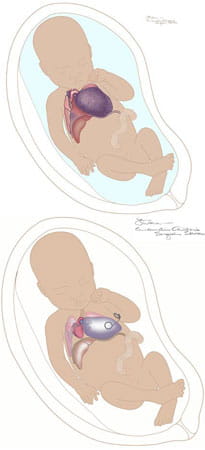
Fetal surgery for CCAM is performed with maternal laparotomy with exposure of the uterus and ultrasound to determine the orientation of the fetus and the placenta to plan the hysterotomy in the upper uterine segment overlying the fetal chest. The hysterotomy is made and the fetal arm and chest are exposed, leaving the head and remainder of the body within the amniotic sac. A fetal thoracotomy exposes the lobe containing the CCAM. The mass is exteriorized, and any systemic feeding vessels and the pulmonary vein draining the CCAM are ligated.
An attempt is made to preserve normal adjacent lobe or lobes is preserved and dissected from the CCAM using electrocautery. The lobar hilum is divided using a surgical stapler. The thoracotomy is then closed. The fetus is returned to the amniotic cavity and the hysterotomy closed. Ultrasound examinations should be performed to confirm the resolution of placentomegaly and fetal hydrops, which usually takes 1 to 2 weeks.
In addition, ultrasonography is helpful in assessing chorioamniotic separation or low amniotic fluid volume. Similarly, daily fetal echocardiography in the early postoperative period is needed to detect the presence of constriction of the ductus arteriosus and tricuspid regurgitation while the patient is on postoperative indomethacin therapy.
Later, weekly ultrasound studies should be performed to confirm compensatory fetal lung growth. Cesarean section is planned just before term or earlier for uncontrolled premature labor. In survivors of fetal surgery for CCAM the outcome has been excellent, with minimal or no need for postnatal ventilatory support.
Volumes and Outcomes
Neonatal survival rates* for patients with CCAM / CPAM treated and managed by the Fetal Care Center:
- High-risk CPAM (hydrops or CVR > 1.6): 80%
- Low-risk CPAM: 100%
|
| Fetal Therapy for CCAM / CPAM | Volume* |
| Open fetal surgery | 7 |
| EXIT-to-resection | 7 |
| Thoracoamniotic shunt | 10 |
*Feb. 1, 2004, through June 30, 2012
CCAM / CPAM References
Adzick NS, et al: Fetal cystic adenomatoid malformation: Prenatal diagnosis and natural history. Journal of Pediatric Surgery 20:483, 1985.
Cass DL, et al: Cystic lung lesions with systemic arterial blood supply: A hybrid of congenital cystic adenomatoid malformation and bronchopulmonary sequestration. Journal of Pediatric Surgery 32:986, 1997.
Cha I, et al: Fetal congenital cystic adenomatoid malformations of the lung: A clinicopathologic study of eleven cases. American Journal of Surgical Pathology 21:537, 1997.
Crombleholme TM, Coleman B, Hedrick HL, et al: Cystic adenomatoid malformation volume ratio predicts outcome in prenatally diagnosed cystic adenomatoid malformation of the lung. Journal of Pediatric Surgery 37: 331-338, 2002.
Keswani SG, Crombleholme TM, Rychik J, et al: Impact of continuous intraoperative monitoring on outcome of open fetal surgery. Fetal Diag Ther (in press).
MacGillivray TE, et al: Disappearing fetal lung lesions. Journal of Pediatric Surgery 28:1321, 1993.
Mashiach R, et al: Antenatal ultrasound diagnosis of congenital cystic adenomatoid malformation of the lung: Spontaneous resolution in utero. J Clin Ultrasound 21:453, 1993.
McCullagh M, et al: Accuracy of prenatal diagnosis of congenital cystic adenomatoid malformation. Arch Dis Child 71:F111, 1994.
Moran L, et al: Prenatal diagnosis and management of fetal thoracic lesions. Semin Perinatol 18:228, 1994.
Scheller JM, Nelson KB: Does cesarean delivery prevent cerebral palsy or other neurologic problems of childhood? Obstetric Gynecology 83:624, 1994.
Stocker JT, et al: Congenital cystic adenomatoid malformation of the lung: Classification and morphologic spectrum. Hum Pathol 8:155, 1977.
Tsao KJ, Hawgood S, Vu L, et al: Resolution of hydrops fetalis in congenital cystic adenomatoid malformation after prenatal steroids therapy. Journal of Pediatric Surgery (in press).