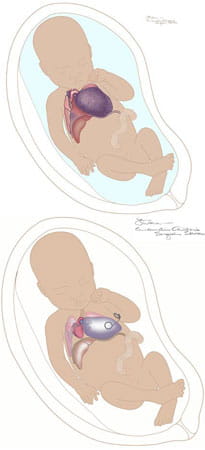
The indications for fetal intervention depend on the type of lesion, whether solid or cystic, and the development of hydrops. In malformations with a dominant cyst, the development of hydrops indicates the need for a thoracentesis or thoracoamniotic shunt to decompress the fluid within the cysts. Thoracentesis alone, however, cannot provide the continuous decompression that thoracoamniotic shunting can. In the rare instances of Congenital Cystic Adenomatoid Malformation (CCAM / CPAM) with a single or a couple of large cysts responsible for hydrops, thoracoamniotic shunting is the treatment of choice.
The first uses of thoracoamniotic shunting in fetuses with CCAM / CPAM were reported in 1987 by Nicolaides and associates and separately by Clark. Percutaneous placement of a thoracoamniotic shunt in a fetus of 20 weeks' gestation decompressed a large type I Congenital Cystic Adenomatoid Malformation, according to Clark, and resolved both the mediastinal shift and hydrops. The infant was successfully delivered at 37 weeks of gestation and then underwent uneventful resection of the CCAM / CPAM. Six subsequent cases of thoracoamniotic shunting in CCAM / CPAM have been reported by Adzick and coworkers, with a good outcome in five of the six fetuses treated, although the survivors had respiratory insufficiency and some have required ECMO or high-frequency ventilation.
A more recent study by Wilson et al found that shunting of macrocystic (type I) CCAM / CPAM resulted in a 51 percent reduction in the CAM volume and resolved the hydrops over seven to ten days. Successful shunting prolonged pregnancy into the third trimester and seven of the ten fetuses treated with thoracoamniotic shunting survived. The authors concluded that a thoracoamniotic shunt should be considered as a treatment option for fetuses with macrocystic (type I) CCAM / CPAM with hydrops or a high risk of developing pulmonary hypoplasia (underdeveloped lungs), and failure of less invasive needle aspiration treatment of the macrocyst fluid (thoracentesis) to prevent rapid reaccumulation of the fluid after one to two aspirations.
Another recent study by Vu et al sought to improve the ability to identify fetuses at especially high risk of developing hydrops because of large CCAM / CPAM. The study focused on large malformations because large size had already been associated with increased risk for developing hydrops. A combination of three features that could be seen by sonogram was associated with hydrops with a large chest mass. These features were: mass-thorax ratio (MTR) of at least 0.56; the predominance of cystic lesions, and inversion or depression of the diaphragm.
With regard to in utero prognosis, poor outcomes are more common in the type III CCAM / CPAM. These microcystic lesions become enlarged, resulting in hydrops and intrauterine fetal demise. In these later cases open fetal surgery and resection are indicated.
High risk CCAM / CPAMs (with a CVP of ≥1.6 or hydrops) should be treated with maternal steroids. We have found that in up to 50 percent of patients, the CCAM / CPAM will stop growing. This allows the baby to grow out of hydrops and for the lungs to develop.
In the case of solid lesions, the development of hydrops manifests by ascites, pleural or pericardial effusions, skin or scalp edema or placentomegaly.
In some cases, maternal steroids appear to arrest the growth of these lesions. This is sometimes a useful temporizing measure. In patients with large, solid CCAM / CPAM with associated hydrops, open fetal surgery is indicated. Without intervention, CCAM / CPAM associated with hydrops is almost always fatal.
In experience with 26 cases of open fetal surgery with hydropic CCAM / CPAM, the survival has been 61 percent. The outcomes for fetal surgery for CCAM / CPAM have been improved by careful observation and by intervention at the earliest signs of hydrops.
In addition, the use of intraoperative echocardiographic fetal monitoring and thoracoabdominal surgical exposure have helped improve outcomes in this surgery. The survival in these cases has increased to 78 percent. Perhaps the best way to improve outcomes in high risk CCAM / CPAM is through close surveillance to identify early signs of hydrops. Too often, patients are referred late in their course presenting with advanced hydrops.
Cases in which CCAM / CPAM are large but have not resulted in hydrops may require resection during an EXIT procedure.
In some cases, the CCAM / CPAM is so sufficiently large that the mediastinum is shifted and the lung compressed. Under these conditions, the lungs may not be able to be ventilated. Removing the CCAM / CPAM during an EXIT procedure allows the lungs to function.
Adzick NS, Harrison MR, Glick PL et al. Fetal cystic adenomatoid malformation: prenatal diagnosis and natural history. J Pediatr Surg 1985;20:483–488.
Adzick NS. Fetal thoracic lesions. Semin Pediatr Surg 1993; 2:103–108.
Adzick NS, Harrison MR. Management of the fetus with a cystic adenomatoid malformation. World J Surg 1993;17: 342–349.
Adzick NS, Harrison MR, Crombleholme TM. Fetal lung lesions: management and outcome. Am J Obstet Gynecol 1998;179:884–889.
Adzick NS, Harrison MR, Flake AW, et al. Fetal surgery for cystic adenomatoid malformations of the lung. J Pediatr Surg 1993;28;806–812.
Adzick NS, Harrison MR, Glick PL, et al. Diaphragmatic hernia in the fetus: prenatal diagnosis and outcome in 94 cases. J Pediatr Surg 1985a;20:357–362.
Adzick NS, Harrison MR, Glick PL, et al. Fetal cystic adenomatoid malformation: prenatal diagnosis and natural history. J Pediatr Surg 1985b;20:483–488.
Atkinson JB, Ford EG, Ketagawa H, et al. Persistent pulmonary hypertension complicating cystic adenomatoid malformations in a neonate. J Pediatr Surg 1972;27: 54–56.
Bailey PV, Tracy T Jr, Connors RH, et al. Congenital bronchopulmonary malformations: diagnostic and therapeutic considerations. J Thorac Cardiovasc Surg 1990;99: 597–603.
Benjamin DR, Cahill JL. Bronchoalveolar carcinoma of the lung and congenital cystic adenomatoid malformation. Am J Clin Pathol 1991;95:889–892.
Bentur L, Canny G, Thoener P, et al. Spontaneous pneumothorax in cystic adenomatoid malformation: unusual clinical and histologic features. Chest 1991;99:1292–1293.
Bezzuti RT, Isler RJ. Antenatal ultrasound detection of cystic adenomatoid malformation of lung: report of a case and review of the recent literature. Clin Ultrasound 1983;11: 342–346.
Boulot P, Pages A, Deschamps F, et al. Early prenatal diagnosis of congenital cystic adenomatoid malformation of the lung (Stocker's type I): a case report. Eur J Obstet Gynecol Reprod Biol 1991;41:159–162.
Budorick NE, Pretorius DH, Leopold SR, et al. Spontaneous improvement of intrathoracic masses diagnosed in utero. J Ultrasound Med 1992;11:653–662.
Carter R. Pulmonary sequestration. Ann Thorac Surg 1959; 7:68–88.
Cass DL, Crombleholme TM, Howello LJ, et al. Cystic lung lesions with systemic arterial blood supply: a hybrid of congenital cystic adenomatoid malformation and bronchopulmonary sequestration. J Pediatr Surg 1997;32: 986–990.
Chinn DH, Filly RA, Callen PW, et al. Congenital diaphragmatic hernia diagnosed prenatally by ultrasound. Radiology 1983;148:119–123.
Clark SL, Vitale DJ, Minton SC, et al. Successful fetal therapy for cystic adenomatoid malformation associated with second trimester hydrops. Am J Obstet Gynecol 1987; 157:294–297.
Cloutier MM, Schaeffer DA, Hight D. Congenital cystic adenomatoid malformation. Chest 1993;103:761–764.
Cone APD, Adam AE. Cystic adenomatoid malformation of the lung (Stocker type III) found on antenatal ultrasound examination. Br J Radiol 1984;57:176–178.
Creasy R. Mirror syndromes: In: Goodlin RC, ed. Care of the fetus. New York: Masson, 1979:48–50.
Crombleholme, TM, Leichtly KW, Howell LJ et al. Cystic adenomatoid malformation volume ratio (CVR) in predicting outcome in CCAM.
D'Agostino S, Bonoldi F, Derote S et al. Embryonal rhabdomyosarcoma of the lung arising in cystic adenomatoid malformation: case report and review of the literature. J Pediatr Surg 1997;32:1381–1383.
D'Alton ME, DeCherney AH. Prenatal diagnosis. N Engl J Med 1993;328;114–120.
Dann SM, Martin JN, White SJ. Antenatal ultrasound findings in cystic adenomatoid malformation. Pediatr Radiol 1981;10:180–182.
Deacon CS, Smart PJ, Rimmer S. The antenatal diagnosis of congenital cystic adenomatoid malformation of the lung. Br J Radiol 1990;63:968–970.
Diwan RV, Brennan JN, Phillipson EH, et al. Ultrasonic prenatal diagnosis of Type III congenital cystic adenomatoid malformation of lung. J Clin Ultrasound 1983;11:218–221.
Fine C, Adzick NS, Doubilet PM. Decreasing size of a congenital cystic adenomatoid malformation in utero: case report. J Ultrasound Med 1988;7:405–408.
Golladay ES, Mollitt PL. Surgically correctable fetal hydrops. J Pediatr Surg 1984;19:59–62.
Gonzalez-cuezzi F, Boggs JD, Raffensberger JG. Brain heterotopia in the lungs: A rare case of respirator disease in the newborn. Am J Clin Pathol 1980;73:281–285.
Harrison MR, Adzick NS, Jennings RW, et al. Antenatal intervention for congenital cystic adenomatoid cystic malformation. Lancet 1990a;336:965–967.
Harrison MR, Adzick NS, Longaker MT, et al. Successful repair in utero of a fetal diaphragmatic hernia after removal of herniated viscera from the left thorax. N Engl J Med 1990b;322:1582–1584.
Heij HA, Ekkelkamp S, Vos A. Diagnosis of congenital cystic adenomatoid malformation of the lung in newborn infants and children. Thorax 1990;45:122–125.
Hernanz-Schulman M. Cysts and cystlike lesions of the lung. Radiol Clin North Am 1993;31:631–649.
Hernanz-Schulman M, Stein IM, Neblett WW, et al. Pulmonary sequestration: diagnosis with color flow sonography and a new theory of associated hydrothorax. Radiology 1991;180:817–821.
Hobbins JC, Grannum PAT, Berkowitz RL, et al. Ultrasound in the diagnosis of congenital anomalies. Am J Obstet Gynecol 1979;134:331–345.
Hubbard AM, Crombleholme TM. Prenatal and neonatal lung lesions. Semin Roentgenol 1998;33:117–125.
Johnson JA, Rumack CM, Johnson ML, et al. Cystic adenomatoid malformation: antenatal demonstration. AJR Am J Roentgenol 1984;142:483–484.
Kuller JA, Yankowitz, J, Goldberg JD, et al. Outcome of antenatally diagnosed cystic adenomatoid malformations. Am J Obstet Gynecol 1992;167:1038–1041.
Leninger BJ, Haight C. Congenital cystic adenomatoid malformation of the left lobe lower lobe with compression of remaining lung. Clin Pediatr 1973;12:182–186.
MacGillivray TE, Adzick NS, Harrison MR, et al. Disappearing fetal lung lesions. J Pediatr Surg 1993;28:1321–1325.
Marcus SF, Lobb MO. The antenatal diagnosis by ultrasonography of type III congenital cystic adenomatoid malformation of the lung: case report. Br J Obstet Gynaecol 1986;93:1002–1005.
May DA, Barth RA, Yeager S, et al. Perinatal and postnatal chest sonography. Radiol Clin North Am 1993;31:499–516.
Mendoza A, Wolf P, Edwards DK, et al. Prenatal ultrasonographic diagnosis of congenital adenomatoid malformation of the lung. Arch Pathol Lab Med 1986;110:402–404.
Mentzer SJ, Filler RM, Phillips J. Limited pulmonary resections for congenital cystic adenomatoid malformation of the lung. J Pediatr Surg 1992;27:1410–1413.
Miller RK, Sieber WK, Yunis EJ. Congenital cystic adenomatoid malformation of the lung: a report of 17 cases and review of the literature. Pathol Annu 1980;1:387–407.
Morin L, Crombleholme TM, Lewis F, et al. Bronchopulmonary sequestration: prenatal diagnosis with clinicopathologic correlation. Curr Opin Obstet Gynecol 1994;6: 479–481.
Murayama K, Jimbo T, Masumoto Y, et al. Prenatal diagnosis and management of some fetal intrathoracic abnormalities. Am J Obstet Gynecol 1987;157;1252–1255.
Neilson IR, Russo P, Faberge JM, et al. Congenital adenomatoid malformation of the lung: current management and prognosis. J Pediatr Surg 1991;26:975–981.
Nicolaides KH, Blatt AJ, Greenough A. Chronic drainage of fetal pulmonary cysts. Lancet 1987;1:618–619.
Nishiboyoshi SW, Andrassy RJ, Woolley MM, et al. Congenital cystic adenomatoid malformation: a 30 year experience. J Pediatr Surg 1982;16:704–706.
Pulpeiro JR, Lopez I, Satelo T, et al. Congenital cystic adenomatoid malformation of the lung in a young adult. Br J Radiol 1987;60:1128–1132.
Rashad F, Gaisoni E, Gaglione S. Aberrant arterial supply in congenital cystic adenomatoid malformation of the lung. J Pediatr Surg 1988;23:107–108.
Rempen A, Feige A, Wiinsch P. Prenatal diagnosis of bilateral cystic adenomatoid malformation of the lung. J Clin Ultrasound 1987;15:3–8.
Roberts JM, Taylor RN, Musci JJ, et al. Preeclampsia: an endothelial cell disorder. Am J Obstet Gynecol 1989;161: 1200–1204.
Romero R, Chernenak FA, Katzen J, et al. Antenatal sonographic findings of extralobar pulmonary sequestration. J Ultrasound Med 1982;1:131–132.
Saltzman DH, Adzick NS, Benacerraf BR. Fetal cystic adenomatoid malformation of the lung: apparent improvement in utero. Obstet Gynecol 1988;71:1000–1003.
Shanji FM, Sachs JH, Perkins DG. Cystic diseases of the lungs. Surg Clin North Am 1988;68:581–618.
Stephanopoulos C, Catsaros MR. Myxosarcoma complicating a cystic hematoma of the lung. Thorax 1963;18:144–145.
Stocker JT, Madewell JER, Drake RM. Congenital cystic adenomatoid malformation of the lung: classification and morphologic spectrum. Hum Pathol 1977;8:155–171.
Szarnicki R, Maurseth K, deLoval M, et al. Tracheal compression by the aortic arch following right pneumonectomy. Ann Thoracic Surg 1978;25:321–324.
Vu L, Tsao KJ, Lee H, et al. Characteristics of congenital cystic adenomatoid malformations associated with nonimmune hydrops and outcome. J Ped Surg 2007; 42:1351-1356.
Walker J, Cudmore RE. Respiratory problems and cystic adenomatoid malformation of the lung. Arch Dis Child 1990;65:649–659.
Wecla K, Grippo R, Unger R, et al. Rhabdomyosarcoma of lung arising in a congenital cystic adenomatoid malformation. Cancer 1977;40:383–388.