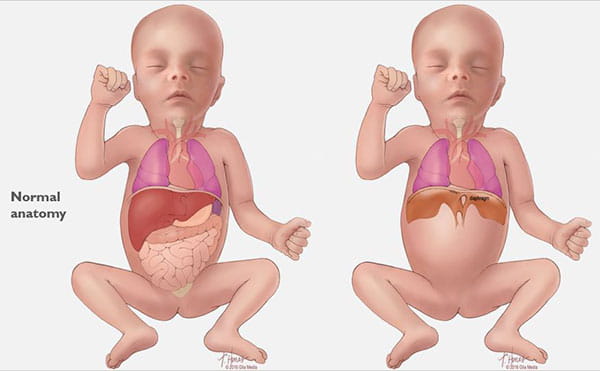
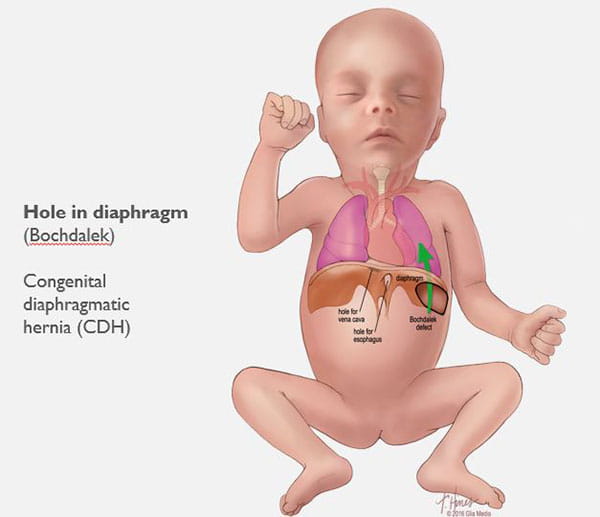
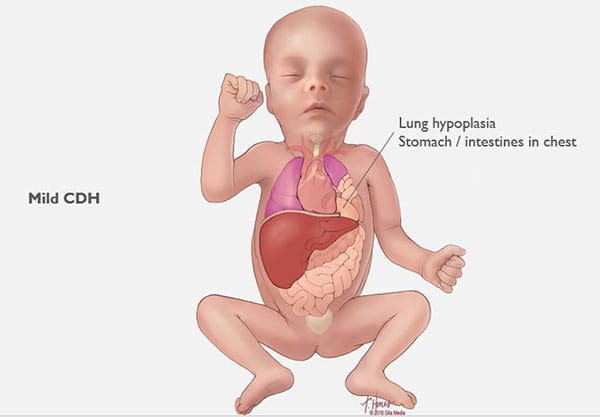
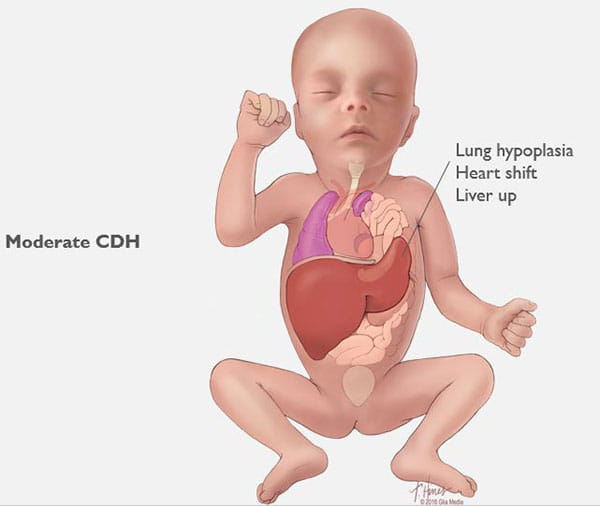
The diagnosis of Congenital Diaphragmatic Hernia / CDH is often an unexpected finding on routine prenatal ultrasound examination or on a scan prompted by polyhydramnios.
Critical ultrasound findings include the presence of viscera in the right or the left hemithorax above the level of the inferior margin of the scapula or at the level of the four-chamber view of the heart. The hypoechoic signal of the fluid-filled stomach, gallbladder, or bowel can be distinguished from the hyperechoic signal of the fetal lung.
A small ipsilateral lung, a defect in the ipsilateral diaphragm, and a shift of the mediastinum away from the affected side are other common findings. In the case of a right-sided Congenital Diaphragmatic Hernia / CDH, the liver may be the only herniated organ, and it is difficult to distinguish it from the fetal lung because of their similar echo densities.
Identification of the diaphragm does not exclude the possibility of Congenital Diaphragmatic Hernia / CDH because at least a small portion of the diaphragm is usually present in Congenital Diaphragmatic Hernia / CDH.
The differential diagnosis includes Type I Congenital Cystic Adenomatoid Malformation of the Lung / CCAM, bronchogenic cysts, neurenteric cysts, and cystic mediastinal teratoma, which may mimic the appearance of a herniated bowel. Identification of abnormal upper abdominal anatomy and presence of peristalsis in herniated bowel loops help distinguish Congenital Diaphragmatic Hernia / CDH from other diagnoses.
The location of the gallbladder in fetuses with Congenital Diaphragmatic Hernia / CDH is helpful because it may be displaced to the midline or in the left upper quadrant or herniated into the right chest.
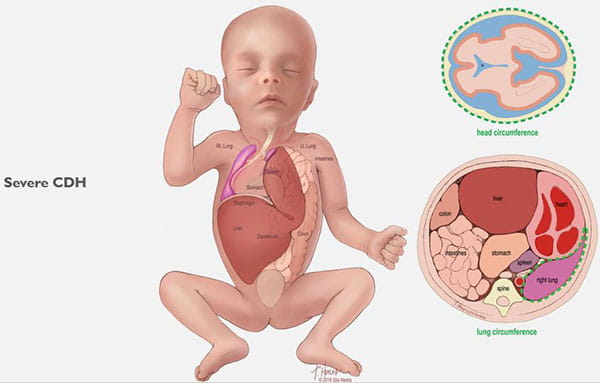
In most severe cases, the liver and the stomach are present in the thorax. Bowing of the portal vein or sinus venosus to the left of the midline or coursing of the portal branches to the lateral segment of the left lobe of the liver above the diaphragm can be seen with color flow Doppler imaging and is the best ultrasound predictor of liver herniation.
In addition, the position of the stomach (easily seen in contrast to the more echogenic fetal lung) in a posterior or midthoracic location is also associated with liver herniation.
Several ultrasound features have been suggested as prognostic indications in Congenital Diaphragmatic Hernia / CDH, including polyhydramnios, early gestation diagnosis (less than 24 weeks), stomach herniation, herniation of the left lobe of the liver, evidence of fetal cardiac ventricular disproportion before 24 weeks of gestation and lung-to-head circumference ratios.
However, no single ultrasound feature of Congenital Diaphragmatic Hernia / CDH has been uniformly helpful in predicting outcome. A more direct estimate of pulmonary hypoplasia that correlates with neonatal outcome is needed.
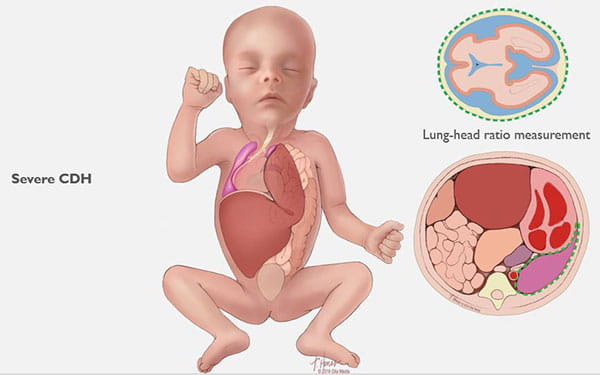
Lung area-to-head circumference ratio (LHR) (two-dimensional area of right lung measured at the level of the four-chamber view of the heart) was assessed prospectively to determine its value in predicting the postnatal outcome with conventional therapy. The LHR, although still useful, has proven less reliable in predicting survival than was previously thought, especially in the most severe category.
LHRs greater than 1. 4 are still associated with an excellent survival rate in the 80 to 85 percent range with only 25 percent of patients requiring ECMO. An LHR between 1. 0 and 1. 4 is associated with survival of about 75 percent, with 69 percent requiring ECMO.
The largest change has been the survival observed with patients with LHR less than 0. 9 in which survival of up to 44 to 62 percent of patients can be expected, but almost all survivors require ECMO.
It is not known if the improved survival with LHR less than 1. 0 reflects improved neonatal care, such as the use of "gentilation" strategies, or if greater experience with larger numbers of patients in this category of LHR is now giving a more accurate reflection of survival.
The position of the fetal liver in left-sided Congenital Diaphragmatic Hernia / CDH remains an important prognostic factor. In recent experience, survival in left sided Congenital Diaphragmatic Hernia / CDH with liver in the abdomen was 91 percent with only 24 percent requiring ECMO.
Conversely, survival in left sided Congenital Diaphragmatic Hernia / CDH with significant herniation of the left lobe of the liver was only 51 percent, with 79 percent of patients requiring ECMO. Note that these statistics apply only to cases of left sided Congenital Diaphragmatic Hernia / CDH.
The LHR does not apply to right-sided Congenital Diaphragmatic Hernia / CDH in which the liver is almost always herniated and it is not necessarily associated with a worse prognosis. In fact, in a review of previous experience with 22 cases of prenatally and six cases of postnatally diagnosed right sided Congenital Diaphragmatic Hernia / CDH, Hedrick et al, found an overall survival rate of 70 percent.
Among those diagnosed prenatally, four cases chose to terminate the pregnancy and of the remaining 18, 16 survived (89 percent, or 73 percent if terminations are included).
Half of the patients (12 of 23, or 53 percent) required ECMO, and of those, the survival rate was 75 percent. Unfortunately, none of the prognostic features that assist in counseling patients with a left-sided Congenital Diaphragmatic Hernia / CDH apply to right-sided Congenital Diaphragmatic Hernia / CDH.
It is noteworthy however, that obstetrical complications including polyhydramnios, pre-term labor, and premature rupture of membranes occurred in 50 percent of the right sided Congenital Diaphragmatic Hernia / CDH pregnancies.
Ultrafast fetal MRI is used to better define the severity of Congenital Diaphragmatic Hernia / CDH, exclude associated anomalies and estimate fetal lung volume as a prognostic indicator.
We recommend fetal MRI two times during gestation. The first MRI is obtained during the initial evaluation in order to demonstrate the anatomic defect and determine whether or not the liver is herniated, which may be difficult to determine with ultrasound alone.
Fetal MRI is useful in excluding other associated abnormalities in the chest, abdomen and brain. We recommend a follow up fetal MRI at 34 to 36 weeks. The lung volumes obtained at this gestational age accurately predict the severity of Congenital Diaphragmatic Hernia / CDH, survival and the need for ECMO.
If you have questions about these prognostic findings on fetal MRI or would like to be evaluated, please contact the Fetal Care Center of Cincinnati.
Despite the advances in neonatal care, such as "gentilation," high-frequency oscillatory ventilation, inhaled nitric oxide, and ECMO, the mortality rate of isolated Congenital Diaphragmatic Hernia / CDH remains substantial. Out of frustration with these grim statistics, Harrison and colleagues pioneered fetal surgery for Congenital Diaphragmatic Hernia / CDH.
Unfortunately, survival following complete in utero repair was poor. These failures were due to herniation of the left lobe of the liver. Reduction of the liver during repair inevitably resulted in kinking of the umbilical vein, leading to fetal bradycardia and cardiac arrest.
Herniation of the left lobe of the liver became an exclusion criterion for complete in utero repair of Congenital Diaphragmatic Hernia / CDH. However, even if cases with left lobe herniation are excluded, the survival rate in the series by Harrison and colleagues was only 41 percent, which was no better than with conventional postnatal therapy at the time.
A prospective trial sponsored by the National Institutes of Health confirmed these findings; thus, there is currently no indication for complete repair of Congenital Diaphragmatic Hernia / CDH in utero. The shortcomings of in utero repair led to the development of a new approach.
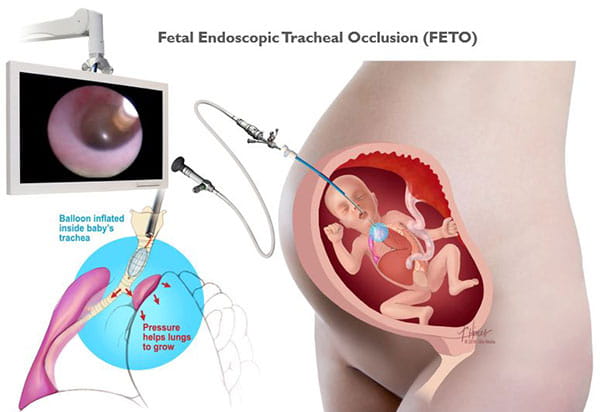
Known for decades, fetal tracheal occlusion results in accelerated fetal lung growth in animal models. It was not until 1994, however, that tracheal occlusion was applied to the problem of Congenital Diaphragmatic Hernia / CDH.
In the animal models of Congenital Diaphragmatic Hernia / CDH, tracheal occlusion induces lung growth, increases alveolar surface area and alveolar number, as well as visceral reduction from the chest.
The results of these experiments were so compelling that fetal tracheal occlusion was applied in human fetuses with severe Congenital Diaphragmatic Hernia / CDH.
The results of open fetal surgery for tracheal clip procedure in high-risk Congenital Diaphragmatic Hernia / CDH were disappointing in both the University of California, San Francisco (UCSF) and the Children's Hospital of Philadelphia (CHOP) experience.
As a result of the poor outcomes with the procedure, a procedure was developed using transuterine endoscopy or FETENDO. The results from the FETENDO approach in high-risk Congenital Diaphragmatic Hernia / CDH were promising, and the NIH sponsored a trial of fetoscopic tracheal clip application compared to conventional postnatal therapy.
Shortly after initiation of the FETENDO trial for Congenital Diaphragmatic Hernia / CDH, the UCSF group developed a less invasive endolumenal balloon tracheal occlusion technique requiring only a single port as opposed to the five for the FETENDO approach. This approach, using a detachable balloon was incorporated into the NIH sponsored trial.
The trial was halted after enrollment and randomization of 24 patients because of an unexpectedly high survival rate with standard postnatal care. The Data and Safety Monitoring Board concluded that further recruitment would not result in significant differences between the groups.
Eight of 11 (73 percent) in the tracheal occlusion group and 10 of 13 (77 percent) in the group that received standard postnatal care survived. There are several important lessons to be learned from this trial.
First, these results primarily apply to fetuses with LHR > 0. 9 and < 1. 4. It remains unknown if the most severely affected fetuses with LHR < 0. 9 and liver herniation would do better with fetal tracheal occlusion.
Second, the outstanding survival achieved with "standard" therapy was obtained at a tertiary center that cares for a large volume of diaphragmatic hernia patients.
These results may not be generalizable to centers that do not have extensive experience caring for critically ill newborns with severe pulmonary hypoplasia due to Congenital Diaphragmatic Hernia / CDH.
In the most severe cases of diaphragmatic hernia, fetal intervention is still being investigated. In Belgium, Jan Deprest was first to perform reversible fetoscopic balloon tracheal occlusion for Congenital Diaphragmatic Hernia / CDH with LHRs < 0. 9 and herniation of the liver.
This therapy is available in Belgium only for left sided Congenital Diaphragmatic Hernia / CDH with herniation of the left lobe of the liver, normal karyotype analysis, normal fetal echocardiogram and no associated anomalies.
EXIT-to-ECMO
The Fetal Care Center offers the EXIT-to-ECMO strategy as treatment for high-risk Congenital Diaphragmatic Hernia / CDH.
The use of EXIT-to-ECMO was first performed by Timothy Crombleholme, MD for the management of severe Congenital Diaphragmatic Hernia / CDH (liver herniation and LHR < 0.9) associated with congenital heart disease.
This has now been applied to cases of isolated high-risk Congenital Diaphragmatic Hernia / CDH:
- Left-sided Congenital Diaphragmatic Hernia / CDH with herniation of the left lobe of the liver and LHR ≤ 0.9, PPLV ≤ 15, TLV ≤ 18 and karyotype with no cardiac defects
- Right-sided Congenital Diaphragmatic Hernia / CDH with PPLV ≤ 15 and TLV ≤ 18
The rationale for this approach is that by transitioning directly from placental support to ECMO support the infant is never hypoxic, acidotic or hypotensive and is never exposed to barotrauma from vigorous neonatal resuscitation. From a maternal risk standpoint, this approach obligates the mother to a surgical delivery.
From the fetal standpoint, because this approach is reserved for high-risk Congenital Diaphragmatic Hernia / CDH, no additional fetal risk is incurred. EXIT-to-ECMO is thought to improve survival in Congenital Diaphragmatic Hernia / CDH with overall survivals of 65 percent in high-risk groups of patients in which survival of 11 to 40 percent is routinely expected.
Adzick NS. On the horizon: neonatal lung transplantation. Arch Dis Child 1992;67:455–457.
Adzick NS, Harrison MR. Fetal surgical therapy. Lancet 1994;343:897–902.
Adzick NS, Harrison MR, Glick PL, et al. Diaphragmatic hernia in the fetus: prenatal diagnosis and outcome in 94 cases. J Pediatr Surg 1985a;20:357–362.
Adzick NS, Outwater KM, Harrison MR, et al. Correction of congenital diaphragmatic hernia in utero IV: an early gestational fetal lamb model for pulmonary vascular morphometric analysis. J Pediatr Surg 1985b;20:673–680.
Adzick NS, Vacanti JP, Lillehei CW, et al. Fetal diaphragmatic hernia: ultrasound diagnosis and clinical outcome in 38 cases from a single medical center. J Pediatr Surg 1981; 24:654–660.
Alcorn D, Adamson T, Lambert T: Morphologic effects of chronic tracheal ligation and drainage in the fetal lamb lung. J Anat 1976;22:649–657.
Areechon W, Reid L. Hypoplasia of the lung associated with congenital diaphragmatic hernia. BMJ 1963;1:230–233.
Bales ET, Anderson G. Diaphragmatic hernia in the newborn: mortality, complications and long-term follow-up observations. In: Kiesewetter WB, ed. Long term follow-up in congenital anomalies. Proceedings from the Pediatric Surgical Symposium. Pittsburgh, 1979;10–20.
Bamforth J, et al. Congenital diaphragmatic hernia, coarse facies, and acral hypoplasia: Fryns Syndrome. Am J Med Genet 1989;32:93–99.
Bealer JF, Skorsgard ED, Hedrick NH, et al. The "plug" odyssey: adventures in experimental fetal tracheal occlusion. J Pediatr Surg 1995;30:361–367.
Beierle EA, Langhorn MR, Cassin S. In utero lung growth in fetal sheep with diaphragmatic hernia and tracheal stenosis. J Pediatr Surg 1996;31:141–146.
Boostaylor BS, Filly RA, Harrison MR, Adzick NS. Prenatal sonographic predictors of liver herniation in congenital diaphragmatic hernia. J Ultrasound Med 1995;14: 515–520.
Boyden EA. Development and growth of the airways. In: Hodson WA, ed. Development of the lung. New York: Marcel Dekker 1977:37–86.
Brachen MB, Berg A. Bendectin (Debendox) and congenital diaphragmatic hernia. Lancet 1983;1:586–587.
Butler N, Claireaux AE. Congenital diaphragmatic hernia as a cause of perinatal mortality. Lancet 1962;1:659–661.
Carmel JA, Friedman F, Adams FH, et al. Fetal tracheal ligation and lung development. Am J Dis Child 1965;109: 452–457.
Carmi R et al. Fryns syndrome: an autosomal recessive disorder associated with craniofacial anomalies, diaphragmatic hernia. Am J Med Genet 1990;36:109–114.
Companale RD, Rowland RH. Hypoplasia of the lung associated with congenital diaphragmatic hernia. Ann Surg 1955;142:17–28.
Connors RH, Tracy T, Bailey PV, et al. Congenital diaphragmatic hernia repair on ECMO. J Pediatr Surg 1990;25: 1043–1047.
Crane JP. Familial congenital diaphragmatic hernia: prenatal diagnostic approach and analysis of twelve families. Clin Genet 1979;16:244–248
Crombleholme TM, Adzick NS, Hardy K, et al. Pulmonary lobar lung transplantation in neonatal swine: a model for the treatment of congenital diaphragmatic hernia. J Pediatr Surg 1990;25:11–18.
Cunniff C, Jones KL, Jones MC. Patterns of malformation in children with congenital diaphragmatic defects. J Pediatr 1990a;116:258–261.
Cunniff C, et al. Fryns syndrome: an autosomal recessive disorder associated with craniofacial anomalies, diaphragmatic hernia, and distal digital hypoplasia. Pediatrics 1990b;85:499–504.
David TJ, Illingworth CA. Diaphragmatic hernia in the southwest of England. J Med Genet 1976;13:253–256.
DeFiore JW, Fauza DO, Slavin R, et al. Experimental tracheal ligation reverses the structural and physiologic effects of pulmonary hypoplasia in congenital diaphragmatic hernia. J Pediatr Surg 1994;29:248–252.
Dillon PW, Filley RE, Hudome SM, et al. Nitric oxide reversal of recurrent pulmonary hypertension and respiratory failure in an infant with CDH after successful ECMO therapy. J Pediatr Surg 1995;30:743–744.
Evans JNG, MacLachlan RF. Choanal atresia. J Laryngol 1971;85:903–905.
Fitzgerald RJ. Congenital diaphragmatic hernia as a cause of perinatal mortality. J Med Sci 1979;146:280–284.
Flake AW, Crombleholme TM, Johnson MD, et al. Treatment of severe congenital diaphragmatic hernia by fetal tracheal occlusion: chemical experience with fifteen cases. Am J Obstet Gynecol (in press).
Frostell CG, Lannquist PA, Sonesson SE, et al. Near fatal pulmonary hypertension after surgical repair of congenital diaphragmatic hernia: successful use of inhaled nitric oxide. Anaesthesia 1993;48:679–683.
Geggel RL, Reid LM. The structural basis of PPHN. Clin Perinatol 1984;2:525–585.
Geggel RL, Murphy JD, Langleben D, et al. Congenital diaphragmatic hernia: Arterial structural changes and persistent pulmonary hypertension after surgical repair. J Pediatr 1985;107:757–764.
Gibbs DL, Rice HE, Farrell JA, et al. Familial diaphragmatic agenesis: an autosomal-recessive syndrome with a poor prognosis. J Pediatr Surg 1997;32:366–368.
Greenwood RD, Rosenthal A, Nodes A. Cardiovascular abnormalities associated with congenital diaphragmatic hernia. Pediatrics 1976;57:92–96.
Harrison MR, Adzick NS, Bullard K, et al. Correction of congenital diaphragmatic hernia in utero VII: a prospective trial. J Pediatr Surg 1997;31:1637–1642.
Harrison MR, Adzick NS, Estes JM, et al. A prospective study of the outcome of fetuses with diaphragmatic hernia. JAMA 1994;271:382–384.
Harrison MR, Adzick NS, Flake AW. Congenital diaphragmatic hernia: an unsolved problem. Semin Pediatr Surg 1993a;2:109–112.
Harrison MR, Adzick NS, Flake AW, et al. Correction of congenital diaphragmatic hernia. VI. Hard earned lessons. J Pediatr Surg 1993b;28:1411–1418.
Harrison MR, Adzick NS, Flake AW, et al. Correction of congenital diaphragmatic hernia in utero VIII: response of the hypoplastic lung to tracheal occlusion in fetuses with diaphragmatic hernia. J Pediatr Surg 1996;31: 1339–1348.
Harrison MR, Adzick NS, Longaker MT, et al. Successful repair in utero of a fetal diaphragmatic hernia after removal of herniated viscera from the left thorax. N Engl J Med 1990a;322:1582–1584.
Harrison MR, Bjordal RI, Landmark F, et al. Congenital diaphragmatic hernia: the hidden mortality. J Pediatr Surg 1979;13:227.
Harrison MR, Bressack MA, Churg AM. Correction of congenital diaphragmatic hernia in utero. II. Simulated correction permits fetal lung growth with survival at birth. Surgery 1980a;88:260–268.
Harrison MR, Golbus MS, Filly RS. The unborn patient: prenatal diagnosis and treatment. 2nd ed. Philadephia: Saunders 1991:295–312.
Harrison MR, Jester JA, Ross NA. Correction of congenital diaphragmatic hernia in utero. I. The model: intrathoracic balloon produces fatal pulmonary hypoplasia. Surgery 1980b;88:174–182.
Harrison MR, Langer JC, Adzick NS, et al. Correction of congenital diaphragmatic hernia in utero. V. Initial clinical experience. J Pediatr Surg 1990b;25:47.
Harrison MR, Mychaliska GB, Albanese CT et al. Correction of congenital diaphragmatic hernia IX: fetuses with poor prognosis (liver herniation and low long-to-head ratio) can be saved fetoscopy temporary tracheal ascension. J Pediatr Surg 1998;33:1017–1022.
Harrison MR, Ross NA, deLorimier AA. Correction of congenital diaphragmatic hernia in utero. III. Development of a successful surgical technique using abdominoplasty to avoid compromise of umbilical blood flow. J Pediatr Surg 1981;16:934–942.
Harrison MR, Keller RL, Howgood SB, Kitterman JA, Sandby P, Farmer DL, Lee H, Filly RA, Farrell JA, Albonese CT: A randomized trial of fetal endoscopic tracheal occlusion for severe fetal congenital diaphragmatic hernia. N Engl J Med 349(20): 1916-1924, 2003.
Hasegawa T, Kamata S, Imura K, et al. Use of lung-thorax transverse area ratio in the antenatal evaluation of lung hypoplasia in congenital diaphragmatic hernia. J Clin Ultrasound 1990;18:705–709.
Hazebrock FWJ, Pattenier JW, Tibboel D, et al. Congenital diaphragmatic hernia: the impact of preoperative stabilization. J Pediatr Surg 1989;24:678–674.
Hedrick MH, Estes JM, Sullivan KM, et al. Plug the lung until it grows (PLUG): a new method to treat congenital diaphragmatic hernia in utero. Surg Forum 1993;44: 644–646.
Hill RM. Infants exposed in utero to antiepileptic drugs. Am J Dis Child 1974;127:645–649.
Hobolth N. Drugs and congenital abnormalities. Lancet 1962;2:1332–1334.
Hooper SB, Man VKM, Harding K. Changes in lung expansion after pulmonary DNA synthesis and IGF-II gene expression in fetal sheep. Am J Physiol 1993;265: 403–406.
Hubbard AM, Adzick NS, Crombleholme TM, et al. Left-sided diaphragmatic hernia: value of prenatal MR imaging in preparation for fetal surgery. Radiology 1997;203: 636–640.
Jennings RW, Adzick NS, Longaker MT, et al. Radiotelemetric fetal monitoring during and after open fetal surgery. Surg Gynecol Obstet 1993;176:59–64.
Kieffer J, Sapin E, Berg A, et al. Gastroesophageal reflex repair of congenital diaphragmatic hernia. J Pediatr Surg 1995;30:1330–1333.
Koot VCM, Bergmeijer JH, Bos BP, et al. Incidence and management of gastroesophageal reflex after repair of congenital diaphragmatic hernia. J Pediatr Surg 1993; 28:48–52.
Kup J. Zwerchfelldefkt nach Abtreibungsnersuch mit Chinin. Munch Med Wochenschr 1967;27:2582–2584.
Langer JC, Filler RM, Bohn DJ, et al. Timing of surgery for congenital diaphragmatic hernia: is emergency operation necessary? J Pediatr Surg 1989;23:731–738.
Lanman JT, Schoffer A, Herod L, et al. Distensibility of the fetal lung with fluid in sheep. Pediatr Res 1971;5: 586–590.
Lesk I, Record RG, McKeoun T, et al. The incidence of malformations in Birmingham, England, 1950–1959. Teratology 1959;1:263–269.
Levin DL. Morphologic analysis of the pulmonary vascular bed in congenital left-sided diaphragmatic hernia. J Pediatr 1978;92:80–85.
Luks FI, Gilchrist BF, Johnson BT, et al. Endoscopic tracheal obstruction with an expanding device in the fetal lamb model. Fetal Diagn Ther 1995;11:67–71.
Lund DP, Mitchell J, Kharasch V, et al. The hidden morbidity of congenital diaphragmatic hernia. J Pediatr Surg 1994;29:258–264.
Metkus AP, Filly RA, Stringer MD, et al. Sonographic predictors of survival in fetal diaphragmatic hernia. J Pediatr Surg 1996;31:148–151.
Moerman P, Fryns J-P et al. The syndrome of hernia, abnormal face and distal limb anomalies (Fryns syndrome): report of two sibs with further delineation of the multiple congenital anomaly (MCA) syndrome. Am J Med Genet 1988;31:805–814.
Moessinger AC, Harding R, Adamson TM, et al. Role of lung fluid in growth and maturation of the fetal sheep lung. J Clin Invest 1990;86:1270–1275.
Morin L, Crombleholme TM, Dalton ME. Prenatal diagnosis and management of fetal thoracic lesions. Semin Perinatol 1994;18:228–253.
Mychaliska GB, Bullard KM, Harrison MR: In utero management of congenital diaphragmatic hernia. Clinics in Perinatal 1996a;23:823–841.
Mychaliska GB, Bealer JE, Graf JL, et al. Operating on placental support: the ex utero intrapartum treatment (EXIT) procedure. J Pediatr Surg 1996b;31.
Nagaya M, Akartsurka H, Kato J: Gastroesophageal reflux occurring after repair of congenital diaphragmatic hernia. J Pediatr Surg 1994;29:1447–1451.
Natuzzi ES, Ursell PC, Harrison MR, et al. Nitric oxide synthase activity in the pregnant uterus decreases at parturition. Biochem Biophys Res Comm 1993;194:1–8.
Nobuhora KK, Lund DP, Mitchell J, et al. Long-term outlook for survivors of congenital diaphragmatic hernia. Clin Perinatol 1996;23:873–887.
Norio R, Kaariainen H, Rapola J, Herva R, Kekomaki M. Familial congenital diaphragmatic defects: aspects of etiology, prenatal diagnosis and treatment. Am J Med Genet 1984;17:471–483.
O'Rourke PP, Vicanti JP, Crane RK, et al. Use of postductal PaO2 as a predictor of pulmonary vascular hypoplasia in infants and congenital diaphragmatic hernia. J Pediatr Surg 1984;23: 904–907.
Pollock LD, Hall JG. Posterolateral (Bochdalek) diaphragmatic hernia in sisters. Am J Dis Child 1979;133: 1186–1189.
Puri P, Gorman F. Lethal nonpulmonary anomalies associated with congenital diaphragmatic hernia: implications for early intrauterine surgery. J Pediatr Surg 1984;19:29–35.
Puri P. Epidemiology of congenital 23:904–7 1984. Diaphragmatic Hernia. Med Prob Paediatr 1989;24:22–28.
Reid L. The lung: its growth and remodeling in health and disease. AJR Am J Roentgenol 1977;129:777–788.
Reynolds M, Luck SR, Lappen R. The "critical" neonate with congenital diaphragmatic hernia. J Pediatr Surg 1984;19: 364–369.
Riemer RK, Busher C, Bansal RK, et al. Increased expression of nitric oxide synthase in the myometrium of the pregnant rat uterus . Am J Physiol 1997;272:E1008–E1015.
Sharland GK, Lockhart SM, Heward AJ. Prognosis in congenital diaphragmatic hernia. Am J Obstet Gynecol 1992; 116:9–13.
Stolar CJH, Berdon WE, Dilon PW: Esophageal dilation and reflux in neonates supported by ECMO after diaphragmatic hernia repair. AJR Am J Roentgenol 1988;151: 135–137.
Stolar CJH, Levy JP, Dillon PW: Anatomic and functional abnormalities of the esophagus in infants surviving congenital diaphragmatic hernia. Am J Surg 1990;159: 204–207.
Stringer MD, Goldstein RB, Filly RA, et al. Fetal diaphragmatic hernia without visceral herniation. J Pediatr Surg 1995;30:1264–1266.
Thorburn MJ, Wright FS, Miller CG, et al. Exomphalos-macroglossia-gigantism syndrome in Jamaican infants. Am J Dis Child 1970;119:316–320.
Tubinsky M, Sevein C, Rapoport JM. Fryns syndrome: a new variable multiple congenital anomaly (MCA) syndrome. Am J Med Genet 1983;14:461–463.
Van Meers KP, Robbins ST, Ried VL. Congenital diaphragmatic hernia: long-term outcome in neonates treated with extracorporeal membrane oxygenation. Journal of Pediatrics 1993; 1222:893–899.
Wilson JM, DiFiore JW, Peters CA. Experimental fetal tracheal ligation prevents the pulmonary hypoplasia associated with fetal nephrectomy: possible application for congenital diaphragmatic hernia. Journal of Pediatric Surgery 1993;28: 1433–1450.
Wolff G. Familial congenital diaphragmatic defect: review and conclusions. Human Genetics 1980;544:1–5.
Wung JT, Sakni R, Moffitt ST, et al. Congenital diaphragmatic hernia: survival treated with very delayed surgery, spontaneous respiration and no chest tube. Journal of Pediatric Surgery 1995;30:406–409.