What is Decannulation?
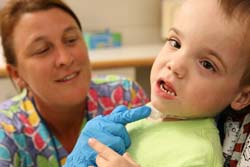 A tracheotomy tube, or trach, is a special breathing tube surgically placed in the neck. Elective decannulation is the process to remove this tube.
After deciding that your child no longer needs the tracheotomy tube to breathe well, your doctor will tell you when you can safely start this process. This process is done slowly to make sure that your child is truly ready for decannulation and will adjust to breathing without the tracheotomy tube.
The steps leading up to decannulation might be different for each child, and may include using a speaking valve, capping the tracheotomy tube, using a smaller tube or putting a hole (fenestration) in the tube. Your doctor will let you know what steps will be needed for your child.
Before the Procedure
After checking your child's airway with a procedure called a microlaryngoscopy and bronchoscopy in the operating room, your doctor may decide that your child can safely begin the decannulation process. Your child will be admitted to the hospital for this procedure, usually for two nights to be observed. It is best if your child has not had anything to eat or drink in the last hour before starting the process.
During the Procedure
The decannulation process will begin with your child completely awake in their own room. When the time comes to take the tracheotomy tube out of the neck, your child's nurse will be there, along with a respiratory therapist and one or more ENT providers (ENT nurse practitioner, ENT fellow, etc.) at the bedside.
An ear, nose and throat doctor or nurse practitioner will take your child's tracheotomy tube out. You or your child may be asked to help. A gauze bandage will be placed over the stoma (the hole in the neck that the tube was in) and taped to your child's neck. Your child will be placed on a heart monitor and pulse oximeter for the first 24 hours after decannulation. This is done so we staff can watch your child’s breathing rate and oxygen saturations the first day and night following decannulation. During the second day of your child’s hospital stay following the decannulation process, your child may only need the monitors while they are asleep
After the Procedure
Your child's breathing will be watched closely during the next few days and nights in the hospital. The stoma will become very small, almost pinhole in size over the next few weeks. It may or may not close completely on its own. Your child can gently use a fingertip to put pressure over the stoma dressing when coughing or talking to help the stoma become smaller more quickly. A bandage can be used over the stoma site when it is very small but still open. If you can still see an opening at the stoma, see or feel air coming out of the stoma or notice mucous coming out of the stoma or on the dressing, then the stoma is not completely closed.
The nurses and respiratory therapists will review the signs of normal and abnormal breathing with you and how you can help your child if there are changes in their breathing. You will also learn how to care for the stoma, what to do if the skin at the stoma becomes irritated, how to tell if the stoma is closed and CPR and rescue breathing for a child without a tracheotomy tube. If the stoma does not completely close on its own, your doctor may talk with you about surgery to close it in the future.
Stoma Care
Supplies you will need: mild soap and water, small gauze pad with tape or bandage.
To clean the stoma:
- Wash and dry your hands.
- Remove the dressing or bandage.
- Clean the stoma and surrounding skin with mild soap and rinse carefully with water. Do not get water in an open stoma.
- Dry the area completely.
- Place a clean gauze or bandage over the stoma.
- Wash and dry your hands.
Activity
Sunscreen should be used on the skin all the way around the neck to keep it from burning or healing poorly.
Your child is not allowed to swim or go underwater until the stoma is completely closed. Your doctor will tell you if the stoma is closed when you come back for the next visit.
When to Call Your Child's Doctor:
Call your child's doctor if your child is not breathing normally or if you have questions.



