What is Vesicoureteral Reflux (VUR)?
To understand vesicoureteral (ves-ih-ko-yu-ree-ter-ul) reflux, you will need to understand the normal structure and function of the urinary tract.
The Urinary System
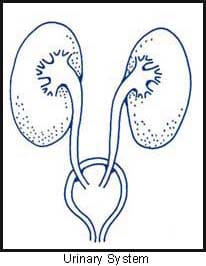
Once in the bladder, the urine is stopped from going back into the ureters by a valve mechanism. When the bladder gets full, it sends a message to the brain. The brain decides when urination should start. The bladder contracts while the control muscle relaxes. This allows the bladder to squeeze all of the urine out.
Reflux
What Is VUR? Vesicoureteral reflux (VUR) is a condition in which urine from the bladder is able to flow back up into the ureter and kidney. It is caused by a problem with the valve mechanism. Pressure from the urine filling the bladder should close the tunnel of the ureter. It should not allow urine to flow back up into the ureter. When the ureter enters the bladder at an unusual angle reflux can can occur. This can also happen when the length of the ureter that tunnels through the bladder wall is too short.
VUR becomes a problem when the urine in the bladder gets infected. The infected urine travels backward to the kidney. This can cause a kidney infection. Kidney infections lead to kidney damage.
Diagnosis of Vesicoureteral Reflux
VUR is most often found during an evaluation for a urinary tract infection (UTI) by your child's primary care provider. After a UTI, a few tests can be ordered.
A voiding cystourethrogram (sis-toe-yu-ree-thro-gram) (VCUG) is an X-ray test. A small tube or catheter is placed into the bladder through the opening where the urine comes out. A special liquid, called X-ray contrast, is used to fill the bladder through the catheter. When the bladder is full, the child will urinate into a special holder while on the X-ray table. While the bladder is filling and the child is urinating, X-rays are taken.
A similar test called nuclear cystogram may be used instead of the VCUG. A catheter is placed and the procedure is like the above test.
A kidney (renal) and bladder ultrasound is a test using sound waves to look for kidney scarring and kidney size. During the ultrasound, a tech will rub warm gel on the child's belly and back. Then, the tech will move a device, which looks like a microphone, on the same places.
Treatment for Vesicoureteral Reflux
Options for treating VUR depend on your specific child and on the doctor.
How VUR is managed, depends on the grade of reflux. This is determined by the VCUG. The frequency of UTIs, the presence and progression of any kidney damage, and the opinion of the parent are also considered.
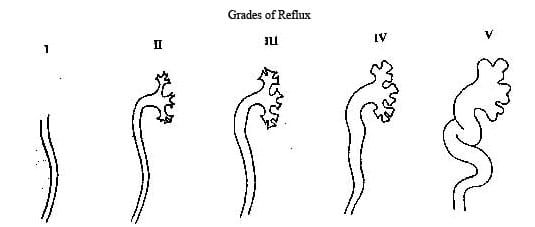
International Reflux Classification. Adapted from (2002) Vesicoureteral Reflux. In: Belman, King, Kramer (eds.) Clinical Pediatric Urology. London, England: Martin Dunitz, Ltd., 753.
For grades I-III there is a good chance that the reflux will go away as the child grows and the bladder matures. These children are given low-dose antibiotics daily. This will suppress bacteria from growing. Occasional blood tests and urine cultures may be ordered.
An option for patients with VUR is a cystoscopy with injection of Deflux. This is a procedure where, under general anesthesia, a small telescope is put into the bladder through the urinary opening. A gel (Deflux) is injected where the ureters enter the bladder. A little bulge is formed in the bladder wall. This prevents the backflow of urine. This is an outpatient procedure.
Patients with "high grade" reflux, grades IV-V, will take low dose antibiotics and have periodic blood tests, X-ray tests and urine cultures done. Some children are treated by watching them closely. This will be a decision made by your child’s doctor. These children may need ureteral reimplantation surgery to correct the reflux and prevent progressive damage of the kidneys if the reflux continues to be problem.
Ureteral Reimplantation Surgery
The goals of surgery are to:
- Correct the reflux
- Prevent pyelonephritis (kidney infection)
- Preserve renal function
This may not totally stop bladder infections. It will reduce the chance that a bladder infection will develop into a kidney infection though.
The ureteral reimplantation surgery consists of making a longer tunnel of the ureter through the bladder wall. The surgery is done through an incision (cut) just above the pubic bone (bikini incision) or laparoscopically. If both ureters need to be reimplanted, this is done through one incision.
This surgery most often lasts between 2½ and three hours. The child may be admitted to the hospital for two to four days after the surgery. Before surgery, the anesthesiologist will discuss a pain management plan with the family.
After Surgery
After open surgery, activity will be limited for four to six weeks. No tub baths for five days. Return to school can be one week after surgery or when no longer taking narcotics for pain control.
After reflux surgery, there may be limits on physical activity. This will be based on what your surgeon decides. Voiding every two to three hours as well as drinking adequate fluids helps healing. Your child may return to school the day after surgery.
Home Care
Healthy bladder habits are vital. These include drinking an adequate amount of water and avoiding bladder irritants in the diet. Good perineal hygiene, even more so in girls, along with voiding every three to four hours, helps to prevent urinary tract infections.