What Are Subcutaneous (Sub-Q) Injections?
A subcutaneous or Sub-Q injection is an injection (shot) given in the fatty tissue just under the skin.
- Some medicines work best when they are given into subcutaneous tissue.
- The subcutaneous tissue is the fatty layer of tissue just under the skin.
- Giving medicines this way is sometimes called “Sub-Q" injection.
- The medicine is absorbed slowly when it is given this way.
When a child first begins getting injections, they might be scared. There are some ways you can help your child feel more comfortable during the injection:
- Test the areas of the skin by pressing gently to see where they are less sensitive.
- Change the place on your child’s body where you give the injection each time and keep track of the sites used.
- Set up a pattern for changing the injection sites and be sure sites are at least one inch apart.
- Distract your child during the injection. For example, allow them to watch TV, sing or look at a book.
Getting Ready
- Wash and dry your hands.
- Choose a place to set up and give the injection that is clean, well lit and flat (like a table).
- Set up your supplies, including an alcohol pad, medicine, gauze pad or cotton ball, and band-aid if needed.
- If you are not using a pre-filled syringe, make sure the syringe has the right amount of medicine and no air bubbles.
Select an Injection Site
1. Possible injection sites:
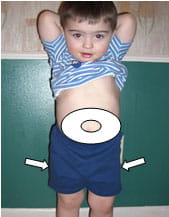
- Outer area/top of legs or belly (at least two inches away from belly button)
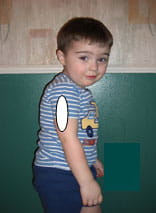
- Back of upper arm between elbow and shoulder
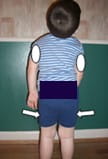
- Outer thighs
2. Use a different site each time you give the medicine. This is to avoid soreness or irritation at any one site.
3. Clean the site with alcohol pad, wiping in circle-like motion.
- If numbing medicine was used, first remove the clear dressing and wipe off numbing medicine with a gauze pad.
Inject the Medicine
- Hold the syringe with the medicine like you are holding a pencil. Remove the needle cover.
- With your other hand, pinch the outside area of the skin that was cleaned with alcohol with your index finger and thumb.
- Quickly push the needle into the skin at a slight angle.
- Relax the pinched skin and slowly push down on the plunger.
- Pull the needle out quickly at the same angle that it went in.
- Cover the site with cotton ball or gauze pad.
- Drop the syringe and needle into a sharps container or a hard plastic container that is approved by your county public health department.
- Apply a band-aid if needed.
Disposal of Needles and Syringes
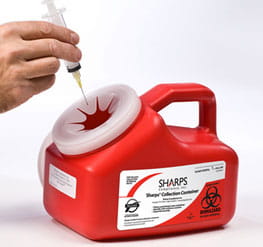
Used needles and syringes should be thrown away in a “sharps” container. This is a hard plastic container and may be given to you by your pharmacy or pharmaceutical company that makes your child’s medicine. These containers are also available to buy.
If you are unable to buy a container, here are some general guidelines to follow to keep your family, neighbors and garbage collectors safe:
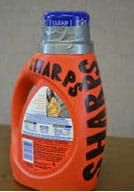
- Use a hard, plastic, puncture-proof container, like an empty laundry detergent bottle.
Note: a 2-liter soda bottle is too thin!
- Tape the lid on the bottle so that it can’t be opened on accident.
- Label the container “SHARPS” in big block letters and place it on top of your trash.
- It is very important for you to contact your trash/waste company to make sure you are disposing of needles and syringes correctly.



