Cornwall / Goh Research Lab
The Cornwall / Goh Lab focuses on researching brachial plexus birth injury (BPB) and cerebral palsy (CP), two of the most common causes of paralysis in children. Both conditions cause secondary contractures, or loss of joint flexibility, that are the primary driver of physical disability and need for surgical treatment. These contractures cannot be cured by existing therapies because the cause of these contractures is unknown.
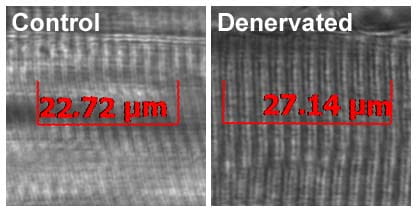
To address this knowledge gap, we developed a mouse model of neonatal brachial plexus injury (NBPI) that precisely mimics the human contracture phenotype of BPBI. Using this model, we discovered that contractures are caused by impaired longitudinal growth of denervated muscle, and that this impaired growth is characterized by overstretched sarcomeres (Figure 1).